

Facing a family dispute in River Pines?
30-90 days to resolution. No lawyer needed.





Facing a Family Dispute in River Pines? Proper Arbitration Preparation Can Protect Your Rights and Outcomes
BMA is a legal tech platform providing self-represented parties with the document preparation and local court data needed to manage California arbitrations independently.
This content is for informational purposes only and does not constitute legal advice. Consult a licensed California attorney for guidance specific to your situation.
Why Your Case Is Stronger Than You Think
Many individuals involved in family disputes underestimate the procedural and evidentiary advantages they possess when properly prepared for arbitration. California law offers robust frameworks that, when leveraged effectively, significantly enhance your position. For instance, the California Arbitration Act (Code of Civil Procedure § 1280 et seq.) ensures that arbitration agreements, if valid and enforceable, uphold your rights to a fair process and enforceable awards. Properly executed arbitration clauses can limit the scope of court intervention, speed up resolution timelines, and reduce costs — provided you understand and adhere to their requirements.
$14,000–$65,000
Avg. full representation
$399
Self-help doc prep
Evidence management plays a crucial role. Well-organized financial documents, communication records, and expert assessments, preserved with chain of custody safeguards, bolster your case's credibility. Recognizing procedural deadlines—such as the 30-day window for claim filing (per AAA rules or institutional guidelines)—and ensuring compliance prevent adverse rulings or dismissals. Emphasizing these procedural strengths shifts the power balance, allowing you to navigate arbitration confidently and secure enforceable outcomes.
What River Pines Residents Are Up Against
River Pines, embedded within California’s family court system, presents unique challenges. The local courts report high volumes of family-related disputes, with over 1,000 cases annually in county courts alone. Data shows a persistent trend of procedural delays and enforcement difficulties, often caused by inadequate documentation or missed deadlines. The California Family Code (Family Code §§ 6300-6360) emphasizes dispute resolution, but enforcement remains inconsistent without proper procedural adherence.
Moreover, ADR programs like AAA and JAMS are increasingly utilized for family issues. However, their case processing times—often extending beyond 90 days—highlight the importance of early, meticulous preparation. Industry patterns reveal that many residents fail to submit complete evidence or neglect to disclose conflicts of interest in arbitrator selection, risking procedural irregularities. The data underscores that those unacquainted with these processes are at greater risk of unfavorable or unenforceable awards.
The River Pines Arbitration Process: What Actually Happens
- Filing the Claim: The process begins with submitting a written demand to the selected arbitration institution (AAA or JAMS), within 30 days of dispute emergence, as governed by California Code of Civil Procedure § 1281.3.
- Exchange of Evidence and Responses: The parties exchange relevant documents and witness lists over a 15- to 30-day period, adhering to rules outlined in the arbitration agreement and AAA rules, which specify strict timelines for disclosure (AAA Commercial Rules Rule R-21).
- Hearing Conduct: The arbitration proceeds with hearings typically scheduled within 45 days of discovery completion. Each side presents evidence, examines witnesses, and submits legal arguments, following procedures under California law (Code of Civil Procedure §§ 1283-1284).
- Arbitral Award: The arbitrator deliberates and issues a written decision usually within 15 days, which is enforceable as a judicial order unless challenged on grounds of procedural irregularity or bias.
Your Evidence Checklist
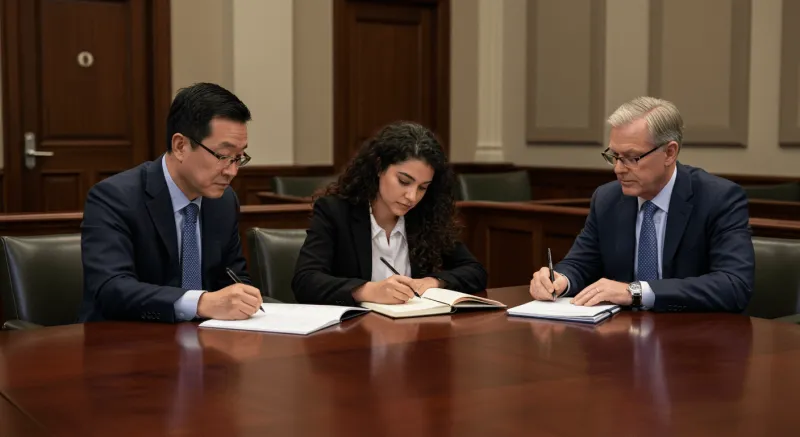
- Financial Documents: Tax returns, bank statements, income histories, and asset documentation—collected at least 20 days before hearings.
- Communication Records: Emails, texts, and recorded conversations that demonstrate conduct or agreements—organized with date stamps and securely preserved.
- Legal Agreements: Marriage certificates, separation agreements, or prior court orders—verified for authenticity and completeness.
- Expert Assessments: Appraisals or evaluations relevant to support valuation or custody claims—obtained from qualified professionals no later than 10 days before hearings.
- Other Supporting Evidence: Photos, video footage, or witness affidavits—prepared and filed following arbitration rule deadlines to prevent inadmissibility.
People Also Ask

Is arbitration binding in California family disputes?
Yes, if the arbitration agreement is valid and voluntarily signed, California courts generally uphold arbitral awards in family disputes, making them binding and enforceable as judgments per Family Code § 6340.
Ready to File Your Dispute?
BMA prepares your arbitration case in 30-90 days. No lawyer needed.
Start Your Case — $399How long does arbitration take in River Pines?
Typically, arbitration in River Pines spans 60 to 120 days from filing to award, depending on case complexity, evidence readiness, and procedural compliance, guided by California Civil Procedure §§ 1280-1294.2.
What documents should I prepare for arbitration?
Key documents include financial statements, communication logs, legal agreements, and expert reports—collected early, organized, and submitted according to deadlines, ensuring their admissibility.
Can arbitration awards in California be challenged?
Yes, but challenges are limited to procedural issues like bias or irregularities outlined under California arbitration statutes (Code of Civil Procedure §§ 1285-1294.2). Timely court filings are essential to preserve your rights.
Don't Leave Money on the Table
Full legal representation typically costs $14,000–$65,000 on average. Self-help document prep: $399.
Start Your Case — $399Why Real Estate Disputes Hit River Pines Residents Hard
With median home values tied to a $83,411 income area, property disputes in River Pines involve stakes that justify proper documentation but rarely justify $14K–$65K in traditional legal fees. Arbitration gives homeowners and tenants a structured path to resolution at a fraction of the cost.
In Los Angeles County, where 9,936,690 residents earn a median household income of $83,411, the cost of traditional litigation ($14,000–$65,000) represents 17% of a household's annual income. Federal records show 902 Department of Labor wage enforcement cases in this area, with $9,479,931 in back wages recovered for 6,013 affected workers — evidence that businesses here have a pattern of cutting corners on obligations.
$83,411
Median Income
902
DOL Wage Cases
$9,479,931
Back Wages Owed
6.97%
Unemployment
Source: U.S. Census Bureau ACS, Department of Labor WHD. IRS income data not available for ZIP 95675.
PRODUCT SPECIALIST
Content reviewed for procedural accuracy by California-licensed arbitration professionals.
About Scott Ramirez

View author profile on BMA Law | LinkedIn | Federal Court Records
Arbitration Help Near River Pines
Arbitration Resources Near
If your dispute in involves a different issue, explore: Family Dispute arbitration in
Nearby arbitration cases: Cupertino real estate dispute arbitration • Travis Afb real estate dispute arbitration • Glendale real estate dispute arbitration • Moss Landing real estate dispute arbitration • Occidental real estate dispute arbitration
References
- California Arbitration Act: California Civil Code § 1280 et seq. https://leginfo.legislature.ca.gov/faces/codes_displaySection.xhtml?sectionNum=1280.1&lawCode=CC
- California Code of Civil Procedure: CCP §§ 1280-1294.2 https://leginfo.legislature.ca.gov/faces/codes_displayText.xhtml?lawCode=CCP&division=&title=4.&part=2.
- AAA Commercial Arbitration Rules: https://www.adr.org/rules
- California Evidence Code: Section 351 https://leginfo.legislature.ca.gov/faces/codes_displaySection.xhtml?sectionNum=351
- California Family Code: https://leginfo.legislature.ca.gov/faces/codes_displayText.xhtml?lawCode=FAM
Local Economic Profile: River Pines, California
N/A
Avg Income (IRS)
902
DOL Wage Cases
$9,479,931
Back Wages Owed
Federal records show 902 Department of Labor wage enforcement cases in this area, with $9,479,931 in back wages recovered for 7,470 affected workers.
What broke first was the assumption that all parties had equally preserved vital communications; this faulty premise undermined the entire arbitration packet readiness controls and left us blind to glaring omissions until too late. At the outset, the checklist appeared airtight: signed disclosures, timeline submissions, and notarized affidavits were all accounted for, fostering a false sense of security. Meanwhile, the silent failure phase unfolded as key messages—critical to understanding the shifting family dynamics—had been deleted or misplaced without any logs or backups, eroding evidentiary integrity in a way we couldn’t detect until final arbitration. Operational constraints tied to the limited scope of document review, combined with entrenched trust in the parties’ self-reporting, created a workflow boundary that we only recognized after the fact. By the time discovery revealed missing communications, reversal was impossible; the damage was permanent and decisively influenced the arbitration outcome in ways the record couldn’t fully amend.
This is a hypothetical example; we do not name companies, claimants, respondents, or institutions as examples.
- False documentation assumption
- What broke first
- Generalized documentation lesson tied back to "family dispute arbitration in River Pines, California 95675"
⚠ HYPOTHETICAL CASE STUDY — FOR ILLUSTRATIVE PURPOSES ONLY
Unique Insight Derived From the "family dispute arbitration in River Pines, California 95675" Constraints
The highly localized context of family dispute arbitration in River Pines introduces unique evidentiary challenges, especially regarding custodianship and the pedigree of submitted documents. The Geographic isolation implies fewer digital service providers and less robust archival infrastructure, increasing vulnerability to silent evidence degradation and loss.
Operational boundaries in managing these cases often arise from limited resources to conduct exhaustive digital forensics, so trade-offs are routinely made in verification depth to maintain timelines. This heightens the risk that early assumptions about document completeness will go unchallenged, perpetuating an irreversible erosion of evidentiary integrity.
Most public guidance tends to omit the implication that habitual familial informality around record-keeping creates endemic unpredictability; thus, workflows must incorporate redundant verification loops specifically designed to compensate for systemic local gaps in record maintenance.
| EEAT Test | What most teams do | What an expert does differently (under evidentiary pressure) |
|---|---|---|
| So What Factor | Accept submitted documents as proxy for facts | Challenge document completeness and cross-validate with independent sources |
| Evidence of Origin | Trust party-provided metadata and timestamps | Scrutinize metadata, perform chain-of-custody discipline, and detect tampering |
| Unique Delta / Information Gain | Focus on volume of documentation | Focus on provenance quality and chronology integrity controls for actionable insight |

