
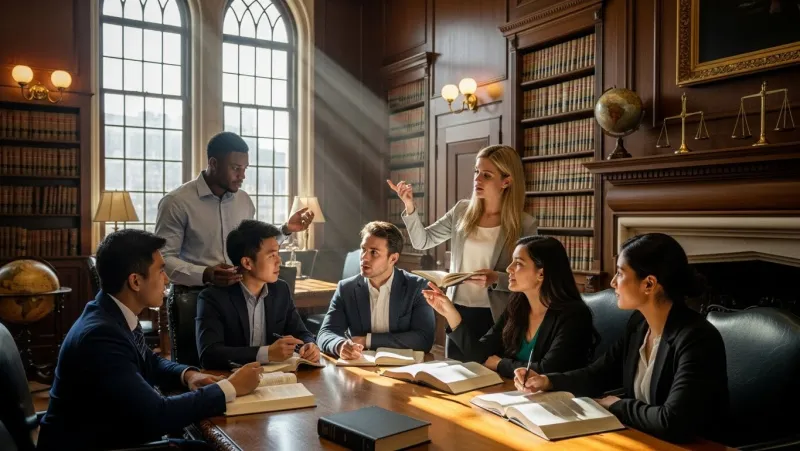
Facing a real estate dispute in Shoshone?
30-90 days to resolution. No lawyer needed.





Facing a Real Estate Dispute in Shoshone? Prepare Your Arbitration Case in Just Weeks
BMA is a legal tech platform providing self-represented parties with the document preparation and local court data needed to manage California arbitrations independently.
This content is for informational purposes only and does not constitute legal advice. Consult a licensed California attorney for guidance specific to your situation.
Why Your Case Is Stronger Than You Think
Many claimants involved in real estate disputes in Shoshone underestimate the strategic advantage of proper documentation and understanding procedural frameworks. Californian law provides significant procedural safeguards and enforceable arbitration agreements, especially when actions are meticulously documented and aligned with statutory requirements. For instance, under the California Arbitration Act (Section 1280.1 of the California Code of Civil Procedure), arbitration clauses in property contracts are presumed valid unless challenged on specific grounds like unconscionability or lack of mutual assent. A claimant who thoroughly reviews and contextualizes their contractual language and maintains a chain of communication will often find they possess a potent leverage point, especially when evidence like property deeds, survey reports, or correspondence is timestamped and verified. Preparation that exploits these procedural and evidentiary advantages can shift the balance decisively, making even complex disputes more manageable and enforceable within arbitration settings.
$14,000–$65,000
Avg. full representation
$399
Self-help doc prep
Furthermore, understanding the critical role of expert reports—such as property appraisals or zoning assessments—can mean the difference between a weak claim and one that dominates arbitration proceedings. Properly prepped claims, aligned with California civil procedure, may be more resistant to defenses based on procedural technicalities, thereby asserting the claimant's substantive rights more effectively. This proactive approach ensures that even in a contested legal environment, the strength of your position is evident, making it less susceptible to procedural challenges or dismissals.
What Shoshone Residents Are Up Against
Inyo County has seen increasing numbers of real estate-related conflicts, with local courts and ADR programs handling dozens of disputes annually. Data indicates that over the past five years, enforcement actions related to property rights, contractual breaches, and zoning conflicts represent a significant portion of docket activities. Small-business owners, property owners, and residents often face challenges such as delayed resolution timelines—averaging 6 to 12 months in court—and high legal costs, which escalate when procedural missteps occur. Notably, enforcement data shows that many disputes are complicated by stakeholders’ lack of awareness of arbitration options, resulting in unnecessary litigation or delayed settlements. This underlines the importance of early, strategic engagement with arbitration processes, especially given California’s statutes supporting enforceability and procedural clarity.
Residents also confront behavior patterns such as incomplete documentation collection, underestimating the importance of verified records, or not consulting legal professionals during critical stages. The cumulative effect of these issues hampers dispute resolution and may lead to adverse outcomes, emphasizing the need for proactive, informed arbitration preparation.
The Shoshone Arbitration Process: What Actually Happens
In California, arbitration of real estate disputes generally follows these four steps:
- Claim Submission: The claimant files a demand for arbitration, referencing the specific contractual arbitration clause. This must be done within the time limits specified in the underlying agreement—often 30 to 60 days after the dispute arises—per California Civil Procedure Code Section 1281.
- Appointment of Arbitrator and Preliminary Hearing: The AAA or JAMS forum assigns an arbitrator experienced in California real estate law. A preliminary conference typically occurs within 30 days of claim acceptance, clarifying issues, scheduling hearings, and establishing procedural rules, under governance controls rooted in the California Arbitration Act.
- Arbitration Hearing: The process usually unfolds over 2-4 days, with each side presenting evidence, witness testimony, expert reports, and argument. Discovery rights are more limited than in court, but parties can request specific document exchanges under the rules of the arbitration forum. The timeline from filing to decision can vary but generally takes 3–6 months.
- Decision and Enforcement: The arbitrator issues a final award, which is binding and enforceable in California courts under the Uniform Arbitration Act. Enforcement procedures typically follow the entry of a court judgment, with the possibility of challenging the award only under narrow grounds such as evident corruption or bias.
In consideration of local context, it is vital to monitor statutory deadlines meticulously and aim for early engagement with qualified arbitrators, aligning the process with California law for optimal enforcement and procedural efficiency.
Your Evidence Checklist
- Property Deeds and Titles: Official, recorded documents verifying ownership, with recent certified copies obtained within the past 30 days.
- Communication Records: Emails, letters, or text messages exchanged with relevant parties, stored electronically with timestamps.
- Contract Documents: Signed agreements, amendments, or addenda, ideally maintained in digital format with verified signatures.
- Survey and Zoning Data: Current survey reports, zoning permits, or environmental assessments relevant to the dispute.
- Photographs and Videos: Date-stamped media capturing property conditions or alleged violations.
- Expert Reports: Appraisals, valuation reports, or environmental assessments prepared by licensed professionals, submitted well in advance of hearings.
Most claimants overlook retaining copies of all correspondence, which can be critical if disputes escalate. Establish a dedicated folder early, ensure all documents are verified and chronological, and confirm formats meet submission requirements—usually PDF or printed copies for physical evidence. Failing to collect or verify these can weaken your position and complicate arbitration proceedings.
Ready to File Your Dispute?
BMA prepares your arbitration case in 30-90 days. No lawyer needed.
Start Your Case — $399Missing the earliest chain-of-custody discipline proved fatal in a real estate dispute arbitration in Shoshone, California 92384, where the initial deed verification was cross-checked but the deeper title searches went unlinked to the arbitration packet readiness controls. We thought the document intake governance was airtight—every form logged, every endorsement tracked—but during cross-examination, digital timestamp discrepancies emerged that unmasked silent failure in the workflow boundary, revealing data gaps we’d initially missed. By that point, the critical break in chronology integrity controls was irreversible; the window to recapture reliable documentary evidence had closed, and the arbitration's outcome was compromised beyond remediation. Operational constraints meant increasing documentation detail met diminishing returns under time pressures, but this trade-off led directly to a hole in evidence preservation workflow that would haunt us throughout the proceedings. arbitration packet readiness controls were assumed sufficient but subtly failed under the layered complexity of Shoshone’s real estate dispute nuances.
This is a hypothetical example; we do not name companies, claimants, respondents, or institutions as examples.
- False documentation assumption: believing the checklist alone ensured all evidentiary links were intact.
- What broke first: invisible lapse in chain-of-custody discipline during early document verification stages.
- Generalized documentation lesson tied back to "real estate dispute arbitration in Shoshone, California 92384": discrete evidentiary linkages must be independently confirmed, not just logged.
⚠ HYPOTHETICAL CASE STUDY — FOR ILLUSTRATIVE PURPOSES ONLY
Unique Insight Derived From the "real estate dispute arbitration in Shoshone, California 92384" Constraints

In Shoshone, the geographic isolation imposes strict cost implications on evidence gathering, forcing trade-offs in how comprehensively field investigations can be conducted within budget and prosecution timelines. This constraint impacts the completeness of the documentation package, emphasizing the value of precise, technology-enabled record linkage over volume of evidence.
Most public guidance tends to omit how arbitration in smaller locales like Shoshone complicates data validation due to limited access to centralized repositories and potential delays in obtaining official record copies. This necessitates a heavier reliance on digitized chain-of-custody discipline and proactive cross-jurisdictional data sharing protocols.
Finally, the limited pool of local arbitration professionals familiar with real estate nuances in 92384 emphasizes the importance of enhanced internal workflow boundary checks to mitigate knowledge gaps, a cost-intensive but crucial investment that affects the overall integrity of the arbitration packet readiness controls.
| EEAT Test | What most teams do | What an expert does differently (under evidentiary pressure) |
|---|---|---|
| So What Factor | Focus on compiling voluminous evidence quickly, often sacrificing detail verification. | Prioritizes verifying how each piece influences the dispute narrative and arbitrable elements, trimming noise. |
| Evidence of Origin | Assumes listed documents are appropriately sourced and timestamps accurate without independent audit. | Conducts layered timestamp audits and cross-references chain-of-custody logs to root out silent failures early. |
| Unique Delta / Information Gain | Rejects information outside the formal packet, missing subtle source connections. | Integrates corroborative metadata and peripheral records to enhance the evidentiary weight and integrity. |
Don't Leave Money on the Table
Full legal representation typically costs $14,000–$65,000 on average. Self-help document prep: $399.
Start Your Case — $399FAQ
Is arbitration binding in California?
Yes, in California, arbitration agreements are generally enforceable, and the resulting awards are binding unless challenged on specific grounds such as procedural unfairness or arbitrator bias. For property disputes with enforceable clauses, arbitration is often final and can facilitate quicker resolution.
How long does arbitration take in Shoshone?
Typically, arbitration proceedings in Shoshone under California jurisdiction last between 3 to 6 months from claim filing to final award, depending on case complexity, evidence readiness, and arbitrator availability.
Can I recover my legal costs through arbitration?
California law allows for the recovery of arbitration costs if stipulated in the arbitration agreement or awarded by the arbitrator, especially if your claim is successful. However, initial costs such as filing fees and expert reports are your responsibility upfront.
What happens if I don’t meet procedural deadlines?
Missing deadlines can result in the forfeiture of your claim or defense, potentially leading to dismissal or default judgment. It is critical to track all deadlines meticulously using case management tools aligned with California arbitration rules.
Why Contract Disputes Hit Shoshone Residents Hard
Contract disputes in Inyo County, where 625 federal wage enforcement cases prove businesses cut corners, require affordable resolution options. At a median income of $63,417, spending $14K–$65K on litigation is simply not viable for most residents.
In Inyo County, where 18,829 residents earn a median household income of $63,417, the cost of traditional litigation ($14,000–$65,000) represents 22% of a household's annual income. Federal records show 625 Department of Labor wage enforcement cases in this area, with $10,182,496 in back wages recovered for 7,593 affected workers — evidence that businesses here have a pattern of cutting corners on obligations.
$63,417
Median Income
625
DOL Wage Cases
$10,182,496
Back Wages Owed
4.89%
Unemployment
Source: U.S. Census Bureau ACS, Department of Labor WHD. IRS income data not available for ZIP 92384.
Federal Enforcement Data — ZIP 92384
Source: OSHA, DOL, CFPB, EPA via ModernIndexPRODUCT SPECIALIST
Content reviewed for procedural accuracy by California-licensed arbitration professionals.
About Frank Mitchell

View author profile on BMA Law | LinkedIn | Federal Court Records
Arbitration Help Near Shoshone
Arbitration Resources Near
If your dispute in involves a different issue, explore: Real Estate Dispute arbitration in
Nearby arbitration cases: Idyllwild contract dispute arbitration • Carlsbad contract dispute arbitration • Downey contract dispute arbitration • Holt contract dispute arbitration • Valley Springs contract dispute arbitration
References
- California Arbitration Act: https://leginfo.legislature.ca.gov/faces/codes_displaySection.xhtml?sectionNum=1280.1&lawCode=CCP
- California Civil Procedure Code: https://leginfo.legislature.ca.gov/faces/codes_displayText.xhtml?lawCode=CCP&division=5.&title=4.&part=2.&chapter=2.
- California Contract Law Principles: https://www.cacontractlaw.com
Local Economic Profile: Shoshone, California
N/A
Avg Income (IRS)
625
DOL Wage Cases
$10,182,496
Back Wages Owed
In Inyo County, the median household income is $63,417 with an unemployment rate of 4.9%. Federal records show 625 Department of Labor wage enforcement cases in this area, with $10,182,496 in back wages recovered for 8,907 affected workers.

