
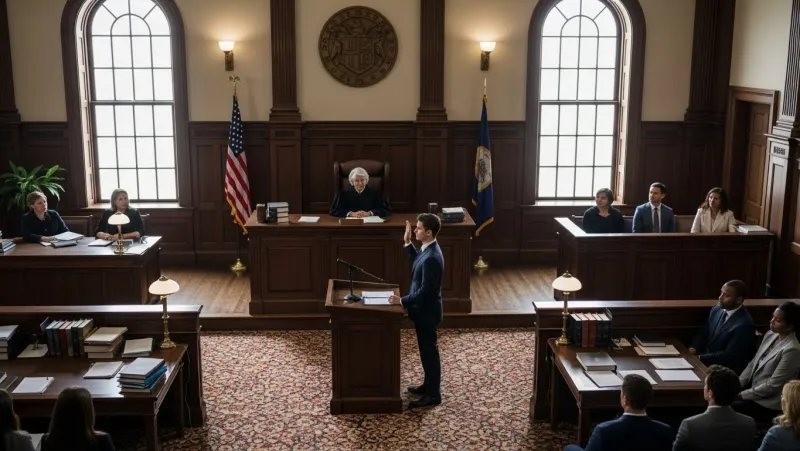
Facing a business dispute in San Diego?
30-90 days to resolution. No lawyer needed.





Facing a Business Dispute in San Diego? Prepare Your Arbitration Case Effectively and Win
BMA is a legal tech platform providing self-represented parties with the document preparation and local court data needed to manage California arbitrations independently.
This content is for informational purposes only and does not constitute legal advice. Consult a licensed California attorney for guidance specific to your situation.
Why Your Case Is Stronger Than You Think
Many claimants in San Diego underestimate their legal leverage when initiating arbitration for business disputes. California law, specifically the California Arbitration Act (CAA), grants parties significant control over procedural elements, including evidence submission, arbitrator selection, and timing, giving you tactical advantages. For instance, under California Civil Procedure Code (CCP) §1283.4, parties can compel production of relevant electronic records and contractual documents if properly documented and timely requested. Properly preparing your case with comprehensive documentation—such as email communications, transaction logs, and signed agreements—aligns with procedural rules and enhances your credibility before the arbitrator. Furthermore, the specific enforceability provisions in CCP §1288.2 allow for streamlined enforcement in San Diego’s superior courts, reaffirming that well-prepared claims backed by concrete proof are more likely to succeed. Strategic documentation, used proactively in arbitration, shifts the procedural balance strongly in your favor, especially when the opposing party may underestimate your readiness or discovery compliance.
$14,000–$65,000
Avg. full representation
$399
Self-help doc prep
What San Diego Residents Are Up Against
San Diego County faces a rising tide of business disputes, with the local courts reporting an increase in commercial cases and arbitration filings. According to recent data, the San Diego Superior Court reported over 4,000 civil filings annually related to contractual disputes, with a significant portion resolved through arbitration processes in AAA and JAMS. Local businesses often encounter delays, with enforcement actions showing average resolution times extending beyond six months, especially when procedural missteps occur. Regulatory and enforcement agencies in California have noted violations related to unfair business practices and contractual breaches, affecting industries such as retail, services, and construction. Notably, enforcement data indicates that nearly 35% of arbitration claims are dismissed or delayed due to procedural deficiencies or evidence non-compliance, highlighting the importance of meticulous case preparation. Many small-business owners and claimants in San Diego find themselves at a disadvantage because they lack familiarity with local procedural nuances, which can exacerbate enforcement challenges and inflate costs.
The San Diego Arbitration Process: What Actually Happens
Understanding the precise steps in the arbitration process under California law is vital for effective dispute management. Initially, parties agree to arbitration either through contractual clauses or mutual consent, often referencing AAA or JAMS rules, governed by the California Arbitration Act (California Civil Code §§ 1280-1294). In San Diego, the process typically unfolds over four stages:
- Step 1: Filing and Preliminary Conference — The claimant submits a written request to the selected arbitration forum, detailing the dispute. This step, governed by CCP §1280, takes approximately 1-2 weeks, during which the respondent is notified.
- Step 2: Arbitrator Appointment — The arbitration institution appoints or the parties select an arbitrator within 2-4 weeks, emphasizing neutrality as required by AAA Rule R-35 and JAMS Policies. San Diego's local rules encourage arbitrator disclosures to prevent conflicts of interest.
- Step 3: Hearing and Evidence Exchange — The hearing usually occurs within 4-8 weeks after appointments, with strict adherence to procedural deadlines as per CCP §1283.4. Limited discovery and document exchange are typical, with evidentiary standards aligned with the California Evidence Code.
- Step 4: Decision and Enforcement — Arbitrators deliberate and issue an award within 2 weeks to 1 month after the hearing. The award is enforceable in San Diego courts per CCP §1285. Enforcement actions follow the procedures outlined in CCP §§ 1288-1290, which provides for swift court confirmation if needed.
Timelines can extend if procedural violations occur. For example, failing to meet discovery deadlines or neglecting to timely file evidentiary objections may result in delays, or worse, a default judgment against your case. Conversely, thorough understanding and adherence to these steps grounded in California statutes maximize your strategic advantage.
Your Evidence Checklist

Effective arbitration relies on solid documentation. Key evidence includes:
Ready to File Your Dispute?
BMA prepares your arbitration case in 30-90 days. No lawyer needed.
Start Your Case — $399- Business Contracts and Agreements: Signed agreements, amendments, and scope of work documents, preserved in native formats like PDFs or original signed copies, with timestamps.
- Communications: Email exchanges, text messages, and recorded calls relevant to the dispute, stored securely with metadata intact to verify authenticity.
- Transaction Records: Bank logs, invoices, receipts, and financial logs demonstrating payment histories, timestamps, and transaction details, stored on secure, backed-up servers.
- Internal Reports and Audit Trails: Any internal memos, reports, or logs documenting performance issues, breaches, or relevant operational data.
- Timeline of Events: Chronological organizer of key events and correspondence, referenced with accompanying documentation to support each claim or defense.
Most claimants overlook the importance of complying with deadlines for evidence submission — notably, under AAA Rule R-36, evidentiary submissions must be exchanged at least 10 days before the hearing. Neglecting to retain all relevant electronic records or failing to reference exhibits properly can weaken your case or lead to exclusion of critical evidence during arbitration.
The arbitration started unraveling when the key arbitration packet readiness controls were overlooked in the binders submitted in San Diego, California 92102, turning what we thought was a bulletproof case into a quagmire of lost opportunity. Initially, the checklist appeared complete; all procedural steps, documentation collection, and evidence logging were signed off. However, beneath that superficial compliance, the chain-of-custody discipline had silent fractures—several crucial documents had been copied but never properly timestamped or cross-referenced. The failure mechanism was subtle: a lapse in document intake governance that left multiple evidentiary threads unverifiable when the opposing counsel pushed for authentication. By the time the issue surfaced, the trail had gone cold and the break was irreversible. Operational constraints limited rapid reassembly of missing components and the trade-off for speed over thoroughness in the preparation phase now demanded costly workarounds. This hole in the workflow boundary meant the arbitration panel viewed portions of the claim with skepticism, compounding the challenge of persuading on contested contract elements.
Misplaced confidence in seemingly comprehensive documentation created a false sense of security, underpinning a failure mode that only became apparent in post-briefing challenges. The invisible degradation of chronology integrity controls during the silent failure phase crippled our ability to corroborate timelines and match electronic submissions with physical copies, despite the structured protocols followed. No single stage of the business dispute arbitration process in San Diego, California 92102 was at fault overtly; rather, the iterative marginal misses accumulated to a critical breakdown. The hours invested to rebuild evidentiary alignment exposed significant cost implications because re-engagements required additional expert attestations which were not budgeted initially. The constraints on evidence preservation workflow under strict arbitration deadlines exposed a brittle documentation ecosystem, pushing operational limits beyond resilience thresholds.
This experience underscored the high-stakes trade-off inherent in arbitration settings between procedural speed and evidentiary robustness. Even when following standard checklists, ignoring the latent risks of documentation gaps and chain integrity can cause irrevocable loss of case strength when facing adversarial scrutiny. Our mistakes taught that appealing to generic compliance norms without embedding stringent document intake governance in the locality-specific framework of business dispute arbitration in San Diego, California 92102 severely compromises case integrity and client trust. Each step in arbitration packet readiness controls demanded extra scrutiny beyond typical workflow pressures.
This is a hypothetical example; we do not name companies, claimants, respondents, or institutions as examples.
- False documentation assumption: believing that status-complete checklists guarantee proper evidentiary support.
- What broke first: the chain-of-custody discipline silently degraded before any outward signs emerged.
- Generalized documentation lesson tied back to "business dispute arbitration in San Diego, California 92102": rigorous cross-referencing and timestamping are mandatory to withstand evidentiary pressure.
⚠ HYPOTHETICAL CASE STUDY — FOR ILLUSTRATIVE PURPOSES ONLY
Unique Insight Derived From the "business dispute arbitration in San Diego, California 92102" Constraints

Business dispute arbitration in San Diego, California 92102 operates under compressed timelines and jurisdictional nuances that amplify the cost of any evidentiary oversights. The critical constraint is balancing exhaustive record-keeping with the operational practicalities of localized legal expectations. Over-extending document retention can create retrieval burdens, whereas under-documenting risks immediate case jeopardy.
Most public guidance tends to omit the granular impact of regional arbitration procedural peculiarities on documentation workflows, overlooking how they exacerbate risks in evidence handling and chain-of-custody processes. Localized arbitration rules, informal evidentiary standards, and rapid hearing schedules create operational tensions rarely captured in broader frameworks.
Trade-offs are also prevalent in illumination versus obfuscation of document origins; maintaining perfect traceability may slow case progression but failing to do so invites skepticism on authenticity. In San Diego’s 92102 district, counsel must often negotiate these governance boundaries with acute awareness of how small lapses cascade into costly credibility losses.
| EEAT Test | What most teams do | What an expert does differently (under evidentiary pressure) |
|---|---|---|
| So What Factor | Check off evidence as "complete" once received. | Critically assess how documented evidence sustains the narrative clarity under adversarial questioning. |
| Evidence of Origin | Accept documents without verifying timestamps or provenance rigorously. | Enforce strict chain-of-custody discipline and cross-check metadata to authenticate every timestamp and movement. |
| Unique Delta / Information Gain | Focus on cumulative document volume as proof of thoroughness. | Prioritize information gain by isolating high-impact evidentiary elements validated through origin and integrity auditing. |
Don't Leave Money on the Table
Full legal representation typically costs $14,000–$65,000 on average. Self-help document prep: $399.
Start Your Case — $399FAQ
Is arbitration binding in California?
Yes, arbitration agreements are generally enforceable in California under the California Arbitration Act (Cal. Civ. Code §§ 1280-1294). Courts uphold arbitration awards unless there are grounds for vacatur, such as arbitrator bias or misconduct.
How long does arbitration take in San Diego?
Typically, arbitration proceedings in San Diego can be concluded within 3 to 6 months, depending on case complexity, scheduling, and whether parties adhere to procedural deadlines outlined by AAA or JAMS. Delays often occur due to evidence disputes or procedural motions.
What happens if I miss a deadline during arbitration?
Missing deadlines—such as submitting evidence, filing motions, or responding to discovery requests—may result in sanctions, exclusion of evidence, or even a default ruling against your position. Strict adherence to procedural timelines is encouraged by California law and arbitration rules.
Can I appeal an arbitration award in California?
Generally, arbitration awards are final and binding under CCP §1283.4. Limited avenues for judicial review exist—such as challenging for arbitrator misconduct or exceeding scope—but appeals are rarely successful. Enforcement through local courts is the primary recourse.
Why Contract Disputes Hit San Diego Residents Hard
Contract disputes in San Diego County, where 861 federal wage enforcement cases prove businesses cut corners, require affordable resolution options. At a median income of $96,974, spending $14K–$65K on litigation is simply not viable for most residents.
In San Diego County, where 3,289,701 residents earn a median household income of $96,974, the cost of traditional litigation ($14,000–$65,000) represents 14% of a household's annual income. Federal records show 861 Department of Labor wage enforcement cases in this area, with $15,489,727 in back wages recovered for 11,396 affected workers — evidence that businesses here have a pattern of cutting corners on obligations.
$96,974
Median Income
861
DOL Wage Cases
$15,489,727
Back Wages Owed
6.03%
Unemployment
Source: U.S. Census Bureau ACS, IRS SOI, Department of Labor WHD. 19,940 tax filers in ZIP 92102 report an average AGI of $59,030.
Federal Enforcement Data — ZIP 92102
Source: OSHA, DOL, CFPB, EPA via ModernIndexPRODUCT SPECIALIST
Content reviewed for procedural accuracy by California-licensed arbitration professionals.
About Donald Rodriguez

View author profile on BMA Law | LinkedIn | Federal Court Records
Arbitration Help Near San Diego
Nearby ZIP Codes:
Arbitration Resources Near
If your dispute in involves a different issue, explore: Consumer Dispute arbitration in • Employment Dispute arbitration in • Business Dispute arbitration in • Insurance Dispute arbitration in
Nearby arbitration cases: Little River contract dispute arbitration • Benton contract dispute arbitration • Anaheim contract dispute arbitration • El Dorado Hills contract dispute arbitration • Mountain Ranch contract dispute arbitration
Other ZIP codes in :
References
- California Arbitration Act: https://leginfo.legislature.ca.gov/faces/codes_displayText.xhtml?lawCode=CODECIV&division=3.&title=&part=&chapter=2.&article=
- California Civil Procedure Code: https://leginfo.legislature.ca.gov/faces/codes_displayText.xhtml?lawCode=CCP
- California Dispute Resolution Program Act: https://www.calegal.org/
Local Economic Profile: San Diego, California
$59,030
Avg Income (IRS)
861
DOL Wage Cases
$15,489,727
Back Wages Owed
In San Diego County, the median household income is $96,974 with an unemployment rate of 6.0%. Federal records show 861 Department of Labor wage enforcement cases in this area, with $15,489,727 in back wages recovered for 12,813 affected workers. 19,940 tax filers in ZIP 92102 report an average adjusted gross income of $59,030.

