
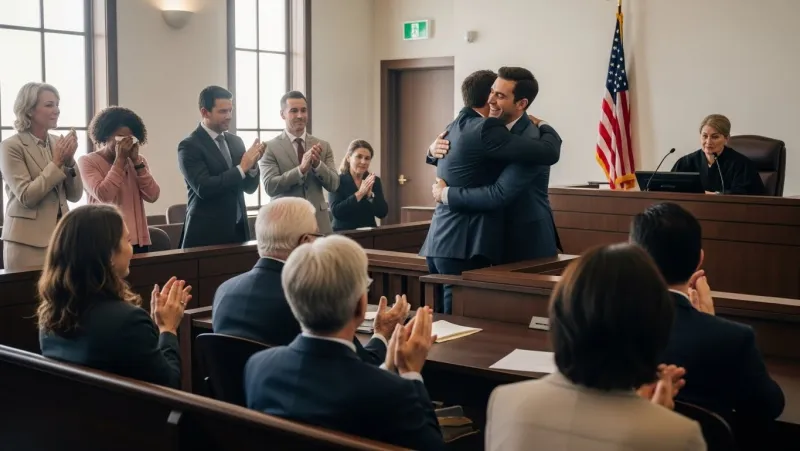
Facing a insurance dispute in Petaluma?
30-90 days to resolution. No lawyer needed.





Denied Insurance Claim in Petaluma? Prepare for Effective Arbitration to Protect Your Rights
BMA is a legal tech platform providing self-represented parties with the document preparation and local court data needed to manage California arbitrations independently.
This content is for informational purposes only and does not constitute legal advice. Consult a licensed California attorney for guidance specific to your situation.
Why Your Case Is Stronger Than You Think
In Petaluma, California, claimants often overlook the procedural advantages embedded within the arbitration process, which can significantly bolster their position. Under the California Arbitration Act (Cal. Code Civ. Proc. §§ 1280 et seq.), parties have enforceable rights to submit disputes regarding coverage, claim denials, or settlement amounts to a binding resolution that often proceeds more swiftly and with fewer procedural hurdles than traditional litigation.
$14,000–$65,000
Avg. full representation
$399
Self-help doc prep
Proper documentation—such as correspondence with the insurer, denial letters, and policy provisions—can be leveraged to demonstrate a clear timeline and substantive breach of contractual obligations. For example, detailed records of communication can establish unexcused delays or unjustified claim denials, aligning with California’s liberal discovery rules (Cal. Civ. Proc. § 2019.410) that allow claimants to obtain pertinent evidence efficiently.
Furthermore, the arbitration agreement itself generally confines the dispute scope and limits cross-examination rights, which, if properly utilized by claimants armed with comprehensive evidence, can shift the negotiation dynamics. As California courts affirm the enforceability of arbitration clauses (see *Armendariz v. Foundation Health Psychcare Services, Inc. (2000) 24 Cal.4th 83*), claimants who prepare meticulously and understand procedural rights often gain considerable leverage, turning defenses into opportunities for early resolution or favorable awards.
This strategic preparation, particularly focusing on compiling all relevant claim records early, significantly increases the chance of a streamlined process where your position is reinforced, and opportunities for the insurer’s procedural objections are minimized.
What Petaluma Residents Are Up Against
Locally, Petaluma's arbitration landscape reflects broader California trends, with many AAA (American Arbitration Association) and JAMS (Judicial Arbitration and Mediation Services) proceedings involving insurance disputes. Recent enforcement data shows a persistent pattern of claim denials across various carriers, especially in property and casualty sectors, with Petaluma-based insurers adhering to standard dispute practices that often favor the insurer unless claimants proactively challenge procedural and substantive issues.
Petaluma’s courts have reported hundreds of cases involving insurance coverage disputes annually, many settling at arbitration but still subject to procedural delays or evidence disputes. These cases often reveal delays in noticing arbitration, incomplete documentation, or insufficient understanding of contractual arbitration clauses. Notably, local consumers and small businesses have experienced multiple instances of declarations that dispute claims are outside the arbitration scope, despite clear contractual language (Cal. Civ. Code § 1632 on arbitration clauses).
California’s regulatory framework emphasizes enforcement of arbitration agreements, but the enforcement data indicates a recurring theme: claimants need to be vigilant. Without early and strategic evidence collection, claimants risk procedural default or inadmissibility of critical evidence, making the process less about the merits and more about procedural technicalities—a critical disadvantage in the dispute resolution arena.
The Petaluma Arbitration Process: What Actually Happens
1. Filing and Notice: The process begins with the claimant submitting a notice of arbitration directly to the chosen administering forum, such as AAA or JAMS, within the timeline set forth in the arbitration agreement—typically within 30 days of violation discovery. This step is governed by California Civil Procedure § 1281.6, which sets requirements for initiating arbitration and ensures parties are properly notified.
2. Answers and Discovery: The respondent, usually the insurer, responds within 20 days, asserting defenses or objections under Cal. Civ. Proc. § 1281.9. Discovery then proceeds, with each party entitled to exchange evidence, including policy documents, denial letters, and communication logs, under the rules specified in the arbitration agreement and the California Civil Discovery Act (Cal. Civ. Proc. §§ 2016.010 et seq.). In Petaluma, local arbitration centers typically allow 60 days for this phase, but strict adherence to deadlines is crucial.
3. Hearing and Evidence Presentation: The parties present their cases in a hearing, which is scheduled approximately 90 days after arbitration commencement in Petaluma hearings. California rules (Cal. Civ. Proc. § 1281.6) authorize arbitrators to conduct evidentiary hearings, where expert reports or witness testimony can be introduced. The arbitrator reviews all evidence, considers legal arguments, and issues a binding award within 30 days of the hearing’s conclusion.
4. Enforcement and Post-Arbitration: The arbitration award in California is enforceable as a judgment per Cal. Civ. Proc. § 1285. If either party challenges the award, limited judicial review is available within 30 days, usually on procedural grounds or arbitrator misconduct, not on disputes over the merits.
Throughout this process, precise adherence to rules, deadlines, and proper evidence handling are essential to secure a favorable outcome within Petaluma's legal framework, which favors well-prepared claimants capable of navigating procedural nuances efficiently.
Your Evidence Checklist

- Insurance Policy: All pages, endorsements, and amendments, especially provisions pertinent to coverage limits and exclusions.
- Correspondence Records: All emails, letters, or communication logs between you and the insurer—date-stamped and organized chronologically.
- Claim Submission Documentation: Copies of claim forms, submission timestamps, and acknowledgment receipts.
- Denial Letters and Explanations: Full copies of denial notices, including specific reasons and policy references, with timestamps.
- Photographs and Videos: Visual evidence of damages or situations claimed under the policy, with date annotations.
- Expert Reports and Assessments: If applicable, appraisals or assessments from qualified professionals, aligned with ARBITRATION deadlines.
- Witness Statements: Affidavits or written statements from witnesses supporting your claim, properly notarized, if needed.
Most claimants forget to compile a complete digital backup of all correspondence and evidence before the arbitration, risking loss of critical documents. Early collection and consistent updating of this evidence are fundamental, especially given California’s rules on discovery and admissibility (Cal. Civ. Proc. § 2019.410).
Ready to File Your Dispute?
BMA prepares your arbitration case in 30-90 days. No lawyer needed.
Start Your Case — $399The arbitration broke first when the claimant’s evidence stream showed gaps nobody noticed during the initial arbitration packet readiness controls checks—everything appeared accounted for until the later stages revealed the underlying chronology had been compromised during document handling. It was a silent failure; the checklist was ticked, digital timestamps matched, and chain-of-custody forms were ostensibly flawless, yet the untraceable transfer of key loss adjustment files allowed subtle alterations that were irreversible once uncovered during the live hearing. Operating under strict deadlines to meet arbitration board submissions meant workflow shortcuts were taken, sacrificing redundant verification steps, embedding a costly trade-off between speed and accuracy that ultimately doomed the integrity of the claim. By the time the discrepancy was flagged, reversing the evidence degradation was impossible, locking the parties into a factual gridlock that extended the dispute unnecessarily, incurring expense and reputational damage for all sides involved.
This is a hypothetical example; we do not name companies, claimants, respondents, or institutions as examples.
- False documentation assumption: relying solely on checklist confirmation without cross-verification allowed corrupted evidence to persist unnoticed.
- What broke first: unnoticed gaps in arbitration packet readiness controls due to constrained handling workflows and time pressures.
- Generalized documentation lesson tied back to "insurance claim arbitration in Petaluma, California 94952": ensuring rigorous and redundant evidence origin protocols are indispensable to uphold arbitration integrity.
⚠ HYPOTHETICAL CASE STUDY — FOR ILLUSTRATIVE PURPOSES ONLY
Unique Insight Derived From the "insurance claim arbitration in Petaluma, California 94952" Constraints

Claims arbitration in Petaluma operates within a tightly regulated local legal environment where evidentiary standards often collide with practical timelines. The pressure to meet procedural deadlines can inadvertently encourage teams to adopt minimal compliance rather than comprehensive documentation, increasing vulnerability to undetected integrity losses. This operational constraint forces a trade-off: prioritize speed or prioritize depth in evidence review.
Most public guidance tends to omit the real risk posed by partial chain-of-custody documentation, where even small breaks can render evidence unreliable in arbitration settings. The pressure to produce voluminous records often leads to checkbox culture rather than forensic-level scrutiny, undermining the process before the dispute even matures.
Another challenge is managing workflow boundaries between multiple stakeholders—agents, adjusters, attorneys—without a unified evidence preservation workflow. In Petaluma’s arbitration market, decentralized handling increases the cost of reconstructing complete claim narratives and demands specialized internal controls to mitigate these risks.
| EEAT Test | What most teams do | What an expert does differently (under evidentiary pressure) |
|---|---|---|
| So What Factor | Assume documented files are sufficient and accurate without further verification. | Continuously validate evidentiary links for every item to assess impact on final arbitration outcomes. |
| Evidence of Origin | Accept chain-of-custody forms as conclusive without cross-referencing metadata and provenance. | Integrate metadata audits alongside physical documentation to confirm true origin and sequence of custody. |
| Unique Delta / Information Gain | Focus on the volume of collected documents rather than unique informational content. | Identify and prioritize evidence that yields new, decision-critical insights rather than redundant data. |
Don't Leave Money on the Table
Full legal representation typically costs $14,000–$65,000 on average. Self-help document prep: $399.
Start Your Case — $399FAQ
Is arbitration binding in California?
Yes. In California, arbitration agreements explicitly specify that awards are final and binding, enforced under Cal. Civ. Proc. § 1285. It generally limits the ability to appeal unless procedural misconduct is proven.
How long does arbitration take in Petaluma?
Typically, the entire process—from filing to award—can be completed within 4 to 6 months if deadlines are met and evidence is properly prepared, according to local arbitration center timelines and California statutes.
Can I represent myself in arbitration or do I need an attorney?
You can self-represent, but having an experienced lawyer familiar with California arbitration law and local practices can improve your chances of success, especially with complex claims or disputes involving substantial coverage issues.
What happens if I lose in arbitration?
The decision is usually final. However, in limited cases, a party can seek court review for procedural errors or arbitrator misconduct under Cal. Civ. Proc. § 1285. Enforceability as a judgment makes it more straightforward to collect on awards.
Are arbitration clauses enforceable if not explicitly signed?
California courts uphold arbitration clauses if they are clearly incorporated into the contract and knowingly agreed to, according to *Armendariz* standards. Silent or hidden clauses may face challenges if procedural fairness is questionable.
Why Contract Disputes Hit Petaluma Residents Hard
Contract disputes in Los Angeles County, where 184 federal wage enforcement cases prove businesses cut corners, require affordable resolution options. At a median income of $83,411, spending $14K–$65K on litigation is simply not viable for most residents.
In Los Angeles County, where 9,936,690 residents earn a median household income of $83,411, the cost of traditional litigation ($14,000–$65,000) represents 17% of a household's annual income. Federal records show 184 Department of Labor wage enforcement cases in this area, with $2,107,018 in back wages recovered for 1,035 affected workers — evidence that businesses here have a pattern of cutting corners on obligations.
$83,411
Median Income
184
DOL Wage Cases
$2,107,018
Back Wages Owed
6.97%
Unemployment
Source: U.S. Census Bureau ACS, IRS SOI, Department of Labor WHD. 16,090 tax filers in ZIP 94952 report an average AGI of $137,310.
Federal Enforcement Data — ZIP 94952
Source: OSHA, DOL, CFPB, EPA via ModernIndexPRODUCT SPECIALIST
Content reviewed for procedural accuracy by California-licensed arbitration professionals.
About Brandon Johnson

View author profile on BMA Law | LinkedIn | Federal Court Records
Arbitration Help Near Petaluma
Nearby ZIP Codes:
Arbitration Resources Near
If your dispute in involves a different issue, explore: Consumer Dispute arbitration in • Employment Dispute arbitration in • Business Dispute arbitration in • Insurance Dispute arbitration in
Nearby arbitration cases: South Pasadena contract dispute arbitration • Pala contract dispute arbitration • Berry Creek contract dispute arbitration • Escondido contract dispute arbitration • Baldwin Park contract dispute arbitration
Other ZIP codes in :
References
- California Arbitration Act: https://leginfo.legislature.ca.gov/faces/codes_displaySection.xhtml?sectionNumber=1280.1&lawCode=CCP
- California Code of Civil Procedure: https://leginfo.legislature.ca.gov/faces/codes_displayText.xhtml?lawCode=CCP&division=&title=4.&part=2.&chapter=4.
- California Judicial Council ADR Resources: https://www.courts.ca.gov/selfhelp-dispute.htm
Local Economic Profile: Petaluma, California
$137,310
Avg Income (IRS)
184
DOL Wage Cases
$2,107,018
Back Wages Owed
Federal records show 184 Department of Labor wage enforcement cases in this area, with $2,107,018 in back wages recovered for 1,108 affected workers. 16,090 tax filers in ZIP 94952 report an average adjusted gross income of $137,310.

