
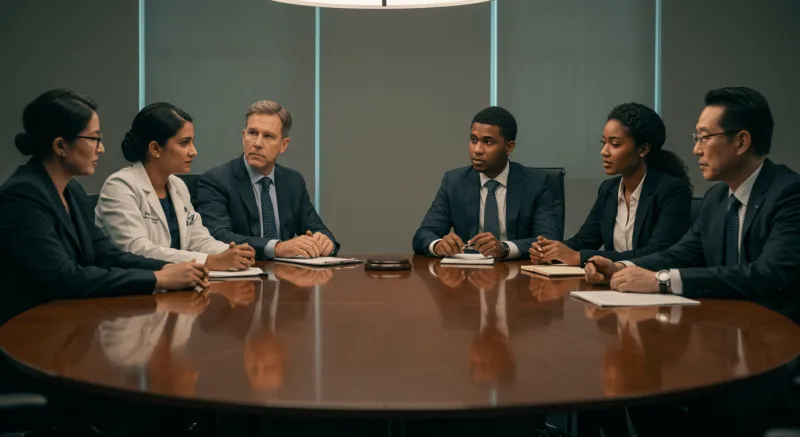
Facing a business dispute in Santa Monica?
30-90 days to resolution. No lawyer needed.





Facing a Business Dispute in Santa Monica? Prepare for Arbitration with Confidence
BMA is a legal tech platform providing self-represented parties with the document preparation and local court data needed to manage California arbitrations independently.
This content is for informational purposes only and does not constitute legal advice. Consult a licensed California attorney for guidance specific to your situation.
Why Your Case Is Stronger Than You Think
Many small-business owners and claimants in Santa Monica underestimate the enforceability of arbitration clauses and the procedural advantages available under California law. Properly crafted documentation—such as clear contractual language, detailed correspondence, and diligent evidence management—can significantly tilt the procedural balance in your favor. For instance, California Civil Code Section 1281.97 emphasizes the enforceability of arbitration agreements, provided they meet statutory standards. When litigants thoroughly review and verify that arbitration clauses conform to California arbitration statutes and California Civil Procedure Code provisions, they position themselves with a higher chance of avoiding procedural dismissals and establishing jurisdiction. Moreover, early and precise evidence collection—gathering contracts, email exchanges, financial records—ensures that claims are substantiated and less vulnerable to procedural challenges. This strategic groundwork maximizes the legal leverage available within Santa Monica’s jurisdiction, where courts and arbitration forums follow strict rules to enforce contractual obligations and procedural standards, as outlined in the California Arbitration Act and AAA rules.
$14,000–$65,000
Avg. full representation
$399
Self-help doc prep
What Santa Monica Residents Are Up Against
Santa Monica and the broader Los Angeles County area have experienced a significant number of violations related to business disputes, contractual breaches, and transactional misrepresentations. According to recent enforcement data from local agencies, there were over 5,000 consumer complaints filed in Los Angeles County in the past year, with a sizable percentage involving small businesses facing alleged breaches or non-compliance with contractual terms. Many of these cases originate from industries with high transaction volumes—retail, service providers, hospitality—that often encounter disputes over scope, payment terms, or delivery obligations. Local businesses frequently encounter delays in dispute resolution and encounter procedural hurdles, especially when arbitration clauses are overlooked or inadequately prepared for. Enforcement data indicates that a considerable portion of cases involving Santa Monica businesses result in formal complaints filed with the California Department of Consumer Affairs or local small claims courts, underscoring the importance of strategic arbitration preparation to mitigate risks and streamline resolution.
The Santa Monica Arbitration Process: What Actually Happens
In Santa Monica, arbitration typically proceeds through four main stages, governed by California arbitration statutes and the rules of chosen arbitration forums such as AAA or JAMS. The process begins with the initiation, where either party files a demand for arbitration—generally within 30 days of dispute escalation—aligning with AAA Commercial Rules, which California courts often recognize. The second phase involves appointment of an arbitrator, either through mutual agreement or, if unresolved, via the forum’s appointment procedures, usually completed within 10 days. The third stage includes the exchange of evidence and preliminary hearings, occurring approximately 30-45 days after appointment, during which procedural compliance is critical. The final stage involves the arbitration hearing itself, which typically lasts 1-3 days but can extend based on case complexity. California Civil Procedure Code sections 1280-1284 govern procedural requirements, including notice service, evidence submission deadlines, and the arbitration award’s enforceability timeframe—generally within 30 days of hearing completion. Local arbitration centers prioritize adherence to these rules to prevent procedural disputes and ensure timely resolution within Santa Monica’s judicial environment.
Your Evidence Checklist

- Contract Documents: Signed agreements, amendments, and related contractual communications. Deadline: Within 7 days of initiating dispute.
- Correspondence Records: Emails, letters, and messages exchanged with opposing parties, showing notice and responses. Format: PDFs or printed copies, stored securely.
- Financial Records: Invoices, receipts, bank statements, and payment confirmations supporting damages claims. Deadline: 14 days before the arbitration hearing.
- Communications for Damages & Breach Proof: Evidence of damages, such as photos of defective products or service failures, and related communication logs. Remember to timestamp and securely store.
- Electronic Evidence: Secure digital copies of all electronic communications, with chain-of-custody documentation to prevent tampering or loss. Implement encryption and backup protocols.
- Legal and Advisory Correspondence: Communications with legal counsel or arbitration consultants to clarify the process, ensuring procedural compliance.
Failure to gather comprehensive evidence and organize it according to these standards can lead to procedural weaknesses, making it easier for the opposing side to challenge your claim or dismiss it altogether at any stage.
Ready to File Your Dispute?
BMA prepares your arbitration case in 30-90 days. No lawyer needed.
Start Your Case — $399People Also Ask

Is arbitration binding in California?
Yes. Under California law, arbitration agreements that meet statutory requirements are generally binding and enforceable. Civil Code Section 1281.2 emphasizes that parties are expected to adhere to arbitration clauses, provided they are entered into voluntarily and with proper capacity.
How long does arbitration take in Santa Monica?
The duration varies depending on case complexity, but typical arbitration proceedings in Santa Monica, following AAA or JAMS rules, last approximately 3 to 6 months from filing to final award, assuming procedural compliance and no delays.
Can I enforce an arbitration award in Santa Monica courts?
Absolutely. California courts routinely recognize and enforce arbitration awards under the California Arbitration Act (Code of Civil Procedure Sections 1280-1294.6). The award has the same effect as a court judgment and can be enforced through standard legal procedures.
What if the opposing party violates arbitration rules?
If a party breaches arbitration procedures—such as failing to produce evidence, disobeying deadlines, or refusing to accept arbitration—it can weaken their position and may result in sanctions or adverse rulings. Proper procedural conduct supported by legal safeguards increases your chances of success.
Don't Leave Money on the Table
Full legal representation typically costs $14,000–$65,000 on average. Self-help document prep: $399.
Start Your Case — $399Why Consumer Disputes Hit Santa Monica Residents Hard
Consumers in Santa Monica earning $83,411/year can't absorb $14K+ in legal costs to fight a company that wronged them. That cost-barrier is exactly what corporations count on — and arbitration at $399 eliminates it.
In Los Angeles County, where 9,936,690 residents earn a median household income of $83,411, the cost of traditional litigation ($14,000–$65,000) represents 17% of a household's annual income. Federal records show 71 Department of Labor wage enforcement cases in this area, with $664,139 in back wages recovered for 607 affected workers — evidence that businesses here have a pattern of cutting corners on obligations.
$83,411
Median Income
71
DOL Wage Cases
$664,139
Back Wages Owed
6.97%
Unemployment
Source: U.S. Census Bureau ACS, Department of Labor WHD. IRS income data not available for ZIP 90408.
PRODUCT SPECIALIST
Content reviewed for procedural accuracy by California-licensed arbitration professionals.
About Andrew Smith

View author profile on BMA Law | LinkedIn | Federal Court Records
Arbitration Help Near Santa Monica
Nearby ZIP Codes:
Arbitration Resources Near
If your dispute in involves a different issue, explore: Employment Dispute arbitration in • Contract Dispute arbitration in • Business Dispute arbitration in • Insurance Dispute arbitration in
Nearby arbitration cases: Upland consumer dispute arbitration • Carson consumer dispute arbitration • Novato consumer dispute arbitration • Tehama consumer dispute arbitration • Clovis consumer dispute arbitration
Other ZIP codes in :
References
- California Arbitration Act: https://leginfo.legislature.ca.gov/faces/codes_displayText.xhtml?lawCode=CIV&division=3.&title=9.&chapter=1.
- California Civil Procedure Code: https://leginfo.legislature.ca.gov/faces/codes_displayText.xhtml?lawCode=CCP
- California Consumer Protection Laws: https://oag.ca.gov/privacy/ccpa
- California Contract Law: https://leginfo.legislature.ca.gov/faces/codes_displayText.xhtml?lawCode=CC
- AAA Commercial Arbitration Rules: https://www.adr.org/Rules
- Evidence Preservation Guidelines: https://www.evidence.com/guidelines
The breakdown started when the arbitration packet readiness controls failed silently amidst a seemingly complete checklist, leaving critical contract correspondence unverified. At face value, the file was airtight: all required documents were presented and the procedural box was checked multiple times, but deeper scrutiny revealed that several key email threads had never been properly archived, compromising timeline integrity. This gap resurfaced late in the arbitration sessions held in Santa Monica, California 90408, where opposing counsel produced conflicting versions of emails and document metadata that had been inadvertently overwritten. The failure propagated through operational constraints — we had limited access to original servers, and digital forensics lagged behind the fast arbitration schedule, forcing us to rely on incomplete local copies. Once the failure was detected, it was irreversible: the missing chain-of-custody discipline had already tainted the credibility of our evidence foundation, and attempts to reconstruct the arbitration packet introduced delays and skepticism that could not be undone. The cost was not just time and operational stress, but a permanent erosion of negotiation leverage due to diminished evidentiary reliability.
This is a hypothetical example; we do not name companies, claimants, respondents, or institutions as examples.
- False documentation assumption: Believing all necessary arbitration materials were intact due to surface-level completeness.
- What broke first: The silent failure of original email archival, invisible in preliminary reviews.
- Generalized documentation lesson tied back to "business dispute arbitration in Santa Monica, California 90408": Always verify the integrity and chain-of-custody of electronically stored evidence beyond checklist compliance to avoid costly evidentiary failures.
⚠ HYPOTHETICAL CASE STUDY — FOR ILLUSTRATIVE PURPOSES ONLY
Unique Insight Derived From the "business dispute arbitration in Santa Monica, California 90408" Constraints
Arbitration in Santa Monica presents rigid time constraints that force teams to prioritize rapid document assembly over exhaustive evidence validation. This introduces a significant trade-off: focusing on procedural compliance often leaves gaps in the evidentiary trail, creating vulnerabilities that can be exploited by opposing parties. Managing this balance requires explicitly accounting for the potential cost of incomplete evidence verification in the project timeline.
Most public guidance tends to omit the nuanced risks of digital evidence degradation within compressed arbitration schedules. In Santa Monica, where technology infrastructures and local rules emphasize speed, the high operational tempo amplifies the risk of silent information loss or metadata corruption. Awareness of these specifics can shift preparation from reactive damage control to proactive evidence preservation workflows.
Another cost implication is the locality-specific limitation on backup retrieval and forensic services, which may not be immediately available or authorized, constraining document intake governance. These constraints force arbitration teams to operate with a narrower margin for error, highlighting the importance of chain-of-custody discipline and real-time integrity monitoring.
| EEAT Test | What most teams do | What an expert does differently (under evidentiary pressure) |
|---|---|---|
| So What Factor | Assume checklist completion means evidence integrity | Continuously question and cross-verify document provenance during assembly |
| Evidence of Origin | Rely on extracted or local copies without chain-of-custody validation | Implement real-time custody tracking and metadata audits for key files |
| Unique Delta / Information Gain | Focus on document volume over qualitative content verification | Prioritize data points that uniquely confirm timeline reliability and authenticity |
Local Economic Profile: Santa Monica, California
N/A
Avg Income (IRS)
71
DOL Wage Cases
$664,139
Back Wages Owed
In Los Angeles County, the median household income is $83,411 with an unemployment rate of 7.0%. Federal records show 71 Department of Labor wage enforcement cases in this area, with $664,139 in back wages recovered for 663 affected workers.

