
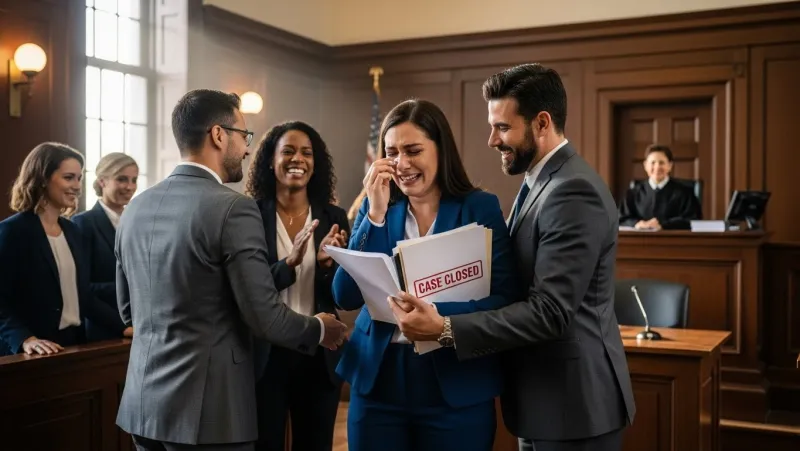
Facing a consumer dispute in Santa Clarita?
30-90 days to resolution. No lawyer needed.





Facing a Consumer Dispute in Santa Clarita? Prepare for Arbitration and Protect Your Rights Efficiently
BMA is a legal tech platform providing self-represented parties with the document preparation and local court data needed to manage California arbitrations independently.
This content is for informational purposes only and does not constitute legal advice. Consult a licensed California attorney for guidance specific to your situation.
Why Your Case Is Stronger Than You Think
Many consumers and small-business owners in Santa Clarita underestimate the leverage they have when preparing for arbitration. When you approach your dispute with meticulously organized documentation and a clear understanding of applicable legal standards, you effectively shift the procedural balance in your favor. California statutes, such as the California Civil Procedure Code, require strict adherence to filing deadlines and evidence rules, but also offer procedural safeguards that, if properly utilized, can reinforce your position.
$14,000–$65,000
Avg. full representation
$399
Self-help doc prep
For example, supporting your claims with proof of transaction records, correspondence, and damage assessments aligns with common arbitration frameworks like those governed by the American Arbitration Association (AAA) rules. These rules emphasize the importance of evidence management and procedural efficiency, which works to your advantage if your documentation aligns with the stipulated standards. Demonstrating that you've preserved relevant evidence according to the rules not only bolsters your credibility but also diminishes the opposing party’s capacity to dismiss your case on procedural grounds.
Furthermore, the enforceability of arbitration clauses in California, under the California Arbitration Act, typically favors consumers who have documented their claims thoroughly and correctly. Because the law mandates a fair, transparent process, a well-prepared case that adheres to procedural requirements can withstand challenges related to agreement enforceability and arbitrator bias. Proper preparation exemplifies compliance with "governance controls" and legal standards, which collectively empower you before the arbitration panel or mediator.
What Santa Clarita Residents Are Up Against
In Santa Clarita, consumer disputes are increasingly common, reflecting broader California trends. Local arbitration and court data indicate a rise in violations related to breach of contract, service deficiencies, and deceptive practices across various industries—ranging from retail to service providers. According to recent enforcement reports, Santa Clarita has seen over 150 consumer complaints filed annually with state and federal agencies, including the California Department of Consumer Affairs.
Local arbitration forums such as AAA and JAMS report an uptick in cases originating from Santa Clarita residents. These disputes often involve complex contractual provisions, where enforcement hinges upon the clarity of documentation and procedural adherence. The reality is that companies involved in consumer disputes have teams of legal professionals focusing on procedural compliance, making it essential for claimants to be equally diligent.
The data reveals a pattern: larger corporations or service providers tend to use arbitration clauses to curtail litigation costs and control dispute outcomes. As a result, Santa Clarita consumers are often disadvantaged by contracts that include mandatory arbitration agreements which can be challenged only if procedural mistakes or incomplete documentation are evident. Your success depends on understanding that procedural gaps—like missing evidence or missed deadlines—can be exploited to dismiss claims unlawfully or prematurely dismiss your case.
The Santa Clarita Arbitration Process: What Actually Happens
The arbitration process in Santa Clarita generally follows four key stages, each governed by specific statutes including the California Civil Procedure Code and rules from the arbitration body involved:
- Filing and Notice: You initiate the dispute by submitting a written claim to the arbitration organization (AA, JAMS), aligned to your contract. This must occur within applicable statutes of limitations, typically two years for personal property damage or breach of contract, as specified under California law. Once filed, the respondent is notified, and a timeline of 30 days to respond is set, per California civil procedure statutes.
- Pre-Hearing Preparation: Both parties exchange evidence, interrogatories, and witness lists, guided by AAA or JAMS rules. Local statutes emphasize prompt discovery exchanges—usually within 15 days of the preliminary hearing—making early organization critical. The arbitrator is selected either through a party agreement or appointed by the arbitration body based on neutrality standards mandated by the California Arbitration Act.
- The Hearing: Typically held within 45 to 60 days of filing, the hearing involves presentation of evidence—documents, witness testimony, and expert reports. California evidence rules influence what evidence is admissible, focusing on relevancy and authenticity. The arbitrator's decision-making process is less formal than court but still bound by procedural fairness and evidentiary standards.
- Decision and Enforcement: Arbitrators deliver a binding award within 15 days of the hearing, pursuant to AAA rules and relevant California statutes. If procedural irregularities occurred—such as excluding critical evidence or arbitrator bias—the decision can be challenged or set aside under certain conditions per the California Arbitration Act, provided documented procedural violations are demonstrated.
This structured process underscores the importance of proactive evidence management and procedural compliance—elements that give Santa Clarita residents a distinct advantage when properly executed.
Your Evidence Checklist

- Transaction Records: Receipts, invoices, contracts, or order confirmations. Collect within days of the dispute, retaining digital and paper copies.
- Correspondence: Emails, texts, and written communications with the opposing party, preserved and organized chronologically to demonstrate attempts at resolution.
- Proof of Damages: Photos, videos, repair estimates, or invoices reflecting financial losses or property damage.
- Witness Statements: Written statements from persons witnessing the transaction or dispute, prepared early and verified for accuracy.
- Legal Documents: Copy of the arbitration agreement, relevant contractual terms, and any prior notices or demand letters.
- Retention Policies: Ensure these documents are not destroyed or overwritten before case completion—set internal reminders aligned with state retention laws.
Most claimants overlook submitting correspondence or fail to obtain formal declarations from witnesses, leading to gaps in evidence that can be exploited by the opposing side. Early and systematic evidence collection is your best defense against procedural dismissals or unfavorable rulings.
Ready to File Your Dispute?
BMA prepares your arbitration case in 30-90 days. No lawyer needed.
Start Your Case — $399The arbitration packet readiness controls silently failed during the consumer arbitration case in Santa Clarita, California 91350, when the opposing party's declaration referenced critical email threads that our archived exhibits did not include. At first, the checklist appeared complete—witness statements were validated, procedural acknowledgments signed, and the submission deadlines met—but the complexity of verifying chain-of-custody discipline for digital communications was underestimated. By the time we realized the evidentiary gap, the arbitration window had closed, and reopening the record was impossible under the strict procedural limits of local arbitration rules. This failure stemmed from an operational trade-off: prioritizing rapid filing over exhaustive cross-referencing of document metadata against the claimant's timeline, which turned out to be a fatal flaw.
This breach in documentation integrity cascaded silently through the workflow unnoticed, as reliance on standardized intake forms gave a false sense of security. Evidence preservation workflow protocols were inadequately tailored for the nuances of consumer arbitration in Santa Clarita, where physical presence is limited and remote communications dominate. The practical constraint of limited client resources compounded pressure to deliver paperwork quickly rather than comprehensively, ultimately compromising the arbitration packet's completeness and reliability.
We can say that this experience sharpens focus on the nuanced demands specific to arbitration packet readiness controls within consumer arbitration in Santa Clarita, California 91350. The consequences underline a hard-learned lesson: that even the most mechanically sound filing processes must pass the "hard" test of granular scrutiny over underlying evidentiary provenance—especially given the jurisdiction's procedural rigidity and the operational environment's emphasis on swift resolution.
This is a hypothetical example; we do not name companies, claimants, respondents, or institutions as examples.
- False documentation assumption: checklists and standardized forms can mask deep evidentiary gaps.
- What broke first: failure to verify chain-of-custody discipline on digital evidence created an irreversible evidentiary breach.
- Generalized documentation lesson tied back to consumer arbitration in Santa Clarita, California 91350: operational constraints and procedural rigidity demand heightened scrutiny of document intake governance.
⚠ HYPOTHETICAL CASE STUDY — FOR ILLUSTRATIVE PURPOSES ONLY
Unique Insight Derived From the "consumer arbitration in Santa Clarita, California 91350" Constraints
Consumer arbitration in Santa Clarita, California 91350, is uniquely constrained by a hybrid legal and procedural framework that places exceptional emphasis on timely submissions but offers very limited remedial options once the record closes. This creates a significant trade-off between speed and accuracy; teams focused on meeting deadlines risk overlooking critical evidentiary gaps that can never be retrospectively corrected. Practices standard in wider civil litigation may not translate directly due to local arbitration nuances.
Most public guidance tends to omit the explicit risks inherent in digital evidence chain-of-custody failure specifically tailored to consumer arbitration environments. Without detailed controls designed for this context, teams may assume general document integrity without actively validating metadata consistency, a blind spot that becomes costly under arbitration pressures.
Another constraint is the operational boundary where many consumer arbitration filings are managed remotely, limiting direct oversight over submission accuracy and completeness. This demands more robust, asynchronous evidence preservation workflows and verification checkpoints than are common in other venues. The cost implication is higher upfront investment in document intake governance to avoid costly irreversible failures.
| EEAT Test | What most teams do | What an expert does differently (under evidentiary pressure) |
|---|---|---|
| So What Factor | Focus on deadline compliance and form completeness | Prioritize deep evidentiary impact analysis on each document before submission |
| Evidence of Origin | Accept client-provided summaries and declarations at face value | Employ detailed chain-of-custody discipline review on all digital and physical evidence |
| Unique Delta / Information Gain | Minimal cross-verification beyond basics | Integrate metadata analysis across multiple evidence sources reflecting local arbitration procedural constraints |
Don't Leave Money on the Table
Full legal representation typically costs $14,000–$65,000 on average. Self-help document prep: $399.
Start Your Case — $399FAQ
Is arbitration binding in California?
Yes. When you sign an arbitration agreement, California law generally enforces it as a binding, enforceable contract unless procedural violations or unconscionability issues are proven. Proper documentation and adherence to procedural rules significantly support enforcement.
How long does arbitration take in Santa Clarita?
Average arbitration processes in Santa Clarita last between 60 to 120 days from filing to decision, depending on the complexity of the dispute and procedural compliance. Timely evidence submission and clear strategy can prevent delays.
Can I challenge an arbitration award in California?
Yes. You can seek to set aside an arbitration award under the California Civil Procedure Code, but only if procedural rules were violated, the arbitrator had a conflict of interest, or the award violates public policy. Documentation showing procedural irregularities is key.
What should I do if the opposing party refuses to cooperate?
File a motion for interim relief or seek court intervention to compel discovery or enforce arbitration clauses. Strict compliance with rules and detailed record-keeping can support your motion.
Why Consumer Disputes Hit Santa Clarita Residents Hard
Consumers in Santa Clarita earning $83,411/year can't absorb $14K+ in legal costs to fight a company that wronged them. That cost-barrier is exactly what corporations count on — and arbitration at $399 eliminates it.
In Los Angeles County, where 9,936,690 residents earn a median household income of $83,411, the cost of traditional litigation ($14,000–$65,000) represents 17% of a household's annual income. Federal records show 862 Department of Labor wage enforcement cases in this area, with $19,935,469 in back wages recovered for 14,180 affected workers — evidence that businesses here have a pattern of cutting corners on obligations.
$83,411
Median Income
862
DOL Wage Cases
$19,935,469
Back Wages Owed
6.97%
Unemployment
Source: U.S. Census Bureau ACS, IRS SOI, Department of Labor WHD. 20,080 tax filers in ZIP 91350 report an average AGI of $116,010.
PRODUCT SPECIALIST
Content reviewed for procedural accuracy by California-licensed arbitration professionals.
About Frank Mitchell

View author profile on BMA Law | LinkedIn | Federal Court Records
Arbitration Help Near Santa Clarita
Nearby ZIP Codes:
Arbitration Resources Near
If your dispute in involves a different issue, explore: Contract Dispute arbitration in • Business Dispute arbitration in • Insurance Dispute arbitration in • Real Estate Dispute arbitration in
Nearby arbitration cases: Eagleville consumer dispute arbitration • San Rafael consumer dispute arbitration • West Hills consumer dispute arbitration • Lookout consumer dispute arbitration • Alleghany consumer dispute arbitration
Other ZIP codes in :
References
- California Department of Insurance — Consumer Resources: insurance.ca.gov
- American Arbitration Association (AAA) — Rules & Procedures: adr.org/Rules
- JAMS Arbitration Rules: jamsadr.com
- California Legislature — Code Search: leginfo.legislature.ca.gov
- California Civil Procedure Code — https://leginfo.ca.gov
- California Arbitration Act — https://law.justia.com/codes/california/2021/ccp/various_sections.html
- California Department of Consumer Affairs — https://www.dca.ca.gov
- American Arbitration Association (AAA) — https://www.adr.org
- Federal Rules of Evidence — https://www.fec.gov
- California Department of Business Oversight — https://dbo.ca.gov
- ABA Dispute Resolution Practice — https://www.americanbar.org/groups/dispute_resolution/
Local Economic Profile: Santa Clarita, California
$116,010
Avg Income (IRS)
862
DOL Wage Cases
$19,935,469
Back Wages Owed
Federal records show 862 Department of Labor wage enforcement cases in this area, with $19,935,469 in back wages recovered for 15,798 affected workers. 20,080 tax filers in ZIP 91350 report an average adjusted gross income of $116,010.

