

Facing a employment dispute in Beverly Hills?
30-90 days to resolution. No lawyer needed.





Facing an Employment Dispute in Beverly Hills? Here Is What Your Case Can Achieve with Proper Preparation
BMA is a legal tech platform providing self-represented parties with the document preparation and local court data needed to manage California arbitrations independently.
This content is for informational purposes only and does not constitute legal advice. Consult a licensed California attorney for guidance specific to your situation.
Why Your Case Is Stronger Than You Think
Many claimants underestimate their ability to influence the outcome of employment arbitration in Beverly Hills by neglecting the critical importance of comprehensive documentation and adherence to procedural rules. Under California law, the enforceability of arbitration agreements is generally supported when they comply with statutory requirements outlined in the California Civil Procedure Code and the California Commercial Code, which govern contractual enforceability. Properly documenting every aspect of the employment relationship, including initial onboarding materials, communications, and performance evaluations, places you well ahead in establishing credibility and damages quantification.
$14,000–$65,000
Avg. full representation
$399
Self-help doc prep
For example, establishing a timeline of notices, warnings, or disciplinary actions in a clear, chronological record allows the arbitrator to accurately assess damages as they would have been if the employment had continued uninterrupted. Statutory provisions such as California Labor Code Section 92.5 emphasize the importance of written agreements for arbitration clauses, and rigorous evidence management ensures these are upheld. When claimants meticulously organize evidence—be it emails, personnel files, or witness statements—they shift the risks away from procedural default and toward substantive merit, creating a more favorable position before the arbitration even begins.
Strategic preparation involving precise documentation and awareness of arbitration rules (like those established by AAA or JAMS) can help claimants secure favorable damages, whether through demonstrating lost wages, benefits, or future income. It also reinforces the legal assertion that damages should place the claimant as close as possible to the position they would have occupied if the employer had not breached or violated employment laws.
What Beverly Hills Residents Are Up Against
Beverly Hills, as part of Los Angeles County, features a high concentration of employment disputes, with the California Department of Fair Employment and Housing reporting hundreds of claims annually related to wrongful termination, discrimination, and wage violations. Data indicates that roughly 60% of employment claims in the region are resolved via arbitration clauses embedded in employment contracts, often outpacing traditional court filings. Many small businesses and individuals unknowingly face procedural hurdles, such as challenges to arbitration agreements or delays in evidence disclosure, which can undermine their case's potential damages.
The local environment is further complicated by the presence of major industry players—luxury hospitality, entertainment, and retail sectors—that often rely heavily on arbitration to resolve disputes swiftly and confidentially. Enforcement statistics reveal that Beverly Hills courts and arbitration forums frequently uphold arbitration agreements, yet procedural missteps, like untimely claims or incomplete evidence submissions, still occur. This underscores the necessity for claimants to be vigilant and fully prepared before entering arbitration, especially given the competitive and high-stakes landscape of Beverly Hills employment disputes.
The Beverly Hills Arbitration Process: What Actually Happens
1. **Filing and Arbitrator Selection**: Once a claimant initiates the process by submitting a claim to an arbitration provider—such as AAA or JAMS—they must do so within statutory timeframes, normally 30 days from the notice of dispute. The arbitration agreement typically specifies the forum and rules governing selection, often allowing parties to choose a sole arbitrator or panel, subject to the California Civil Procedure Code requirements (CCP §§ 1281.6, 1281.7). Beverly Hills cases tend to follow AAA rules, which provide a streamlined process for employment disputes.
2. **Pre-Hearing Procedures and Case Preparation**: Within 30 to 60 days, the arbitrator conducts a procedural conference to set timelines, clarify evidentiary expectations, and establish deadlines. During this phase, the involved parties exchange preliminary disclosures, including relevant documents and witness lists, per the standards in JAMS Rule 21. Claimants should prepare a detailed evidence list and organize exhibits accordingly. The entire process often spans 3-6 months in Beverly Hills, but delays can extend this far beyond if procedural missteps occur.
3. **Hearing and Evidence Presentation**: The arbitration hearing itself usually lasts 1-3 days, during which each side presents evidence, witnesses are called, and the arbitrator rules on objections following the rules of evidence codified in the Federal Rules of Evidence and California Evidence Code. Beverly Hills arbitration cases benefit from strict adherence to confidentiality provisions, which can limit external discovery but also require parties to be proactive in presenting persuasive evidence within the scope allowed. The arbitrator’s rulings typically occur immediately or within a few days after the hearing.
4. **Award and Enforcement**: The arbitrator renders a written decision, which can include damages, injunctive relief, or dismissals. Under the California Arbitration Act, awards are binding and enforceable as court judgments unless challenged on grounds such as arbitrator bias or procedural misconduct (CCP §§ 1285–1287.2). Claimants should review the award promptly and ensure compliance with any post-award procedures, notably to avoid unnecessary delays that could diminish damages recovery.
Your Evidence Checklist

- Employment Records: Signed employment agreements, offer letters, and amendments, ideally with timestamps or signatures. Deadline: Submit or organize before the arbitration hearing.
- Communication Logs: Emails, text messages, and internal memos related to work performance, complaints, or disciplinary actions. Deadline: Collect and preserve from the outset to establish timelines.
- Wage and Benefit Documentation: Pay stubs, timesheets, and benefit statements demonstrating lost wages or benefits. Deadline: conservatively within six months of incident or claim filing.
- Witness Statements: Affidavits or sworn statements from coworkers, supervisors, or experts. Format: clear, signed statements with detailed recollections. Deadline: prepared well in advance of the hearing.
- Relevant Policies and Training Materials: Employee handbooks, training modules, and disciplinary procedures that support your claims or defenses. Deadline: review and compile during early evidence gathering phases.
- Procedural Documentation: Correspondence regarding arbitration notices, submissions, and communications with the arbitral forum. Save all emails and confirmation receipts promptly.
The first crack in handling the evidence chain during the employment dispute arbitration in Beverly Hills, California 90210 came from assuming completeness of the arbitration packet readiness controls, despite subtle inconsistencies emerging too late. The workstream checklist was marked green on every item; document versions were seemingly in lockstep, yet a silent failure phase occurred when metadata discrepancies eroded the traceability of critical communications between parties. This invisible decay was exacerbated by operational constraints — a tight turnaround coupled with a reliance on third-party vendors for document collection — which forced a trade-off between comprehensive vetting and expedient delivery. By the time the issue surfaced, the loss was irreversible: critical emails showing intent and pre-mediation negotiations had incomplete chain-of-custody logging, rendering them inadmissible and irreconcilable with version stamps. The cost implications were sweeping, with delayed hearings and intensified skepticism from arbitrators about the integrity of evidence submission workflows. It was a stark reminder that checklist completion isn’t a proxy for evidentiary fidelity when constrained by volume and accelerated schedules.
Ready to File Your Dispute?
BMA prepares your arbitration case in 30-90 days. No lawyer needed.
Start Your Case — $399This is a hypothetical example; we do not name companies, claimants, respondents, or institutions as examples.
- False documentation assumption: Marking document readiness as complete without verifying metadata fidelity can silently break evidentiary integrity.
- What broke first: Overreliance on surface-level checklist verification masked the early metadata inconsistencies undermining chain-of-custody discipline.
- Generalized documentation lesson tied back to "employment dispute arbitration in Beverly Hills, California 90210": Rigorous audit trails with time-stamped, verifiable controls are indispensable under high-pressure, jurisdiction-specific arbitration conditions.
⚠ HYPOTHETICAL CASE STUDY — FOR ILLUSTRATIVE PURPOSES ONLY
Unique Insight Derived From the "employment dispute arbitration in Beverly Hills, California 90210" Constraints
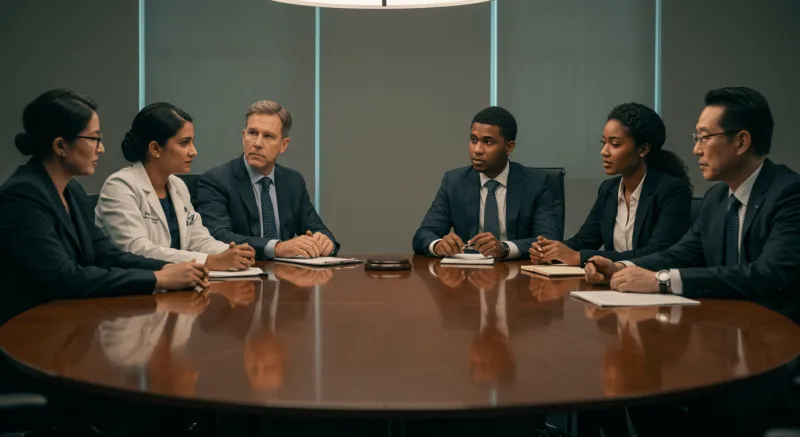
Employment dispute arbitration in Beverly Hills, California 90210 presents a unique set of constraints that shape evidence handling practices. The high-profile, often confidential nature of these cases places an elevated demand on both rapid processing and airtight evidentiary standards. Trade-offs between speed and thoroughness become unavoidable, with the cost of operational efficiency sometimes hidden beneath subtle workflow shortcuts.
Most public guidance tends to omit that reliance on standard document management processes alone is insufficient; the localized legal culture and arbitrator expectations drive an imperative for extra-layered verification, especially concerning communication authenticity and chain-of-custody documentation. The pressure to maintain confidentiality while upholding transparency adds complexity that challenges conventional documentation discipline.
Additionally, the presence of multiple stakeholders — including employers, employees, counsel, and third-party arbitrators — creates workflow boundaries that fragment the evidence intake process. Without explicit synchronization protocols, critical metadata can be lost or corrupted, carrying irreversible consequences long after submission. The cost implication here is severe: once evidence integrity is questioned, the arbitral process risks costly delays or unfavorable credibility assessments.
| EEAT Test | What most teams do | What an expert does differently (under evidentiary pressure) |
|---|---|---|
| So What Factor | Focus on surface-level completeness checks to mark packets as ready. | Integrate layered forensic checks identifying metadata anomalies impacting admissibility. |
| Evidence of Origin | Assume vendor-supplied documents come with intact chain-of-custody. | Manually validate document provenance and cross-check with internal logs for provenance certainty. |
| Unique Delta / Information Gain | Capture only standard file versions and timestamps. | Extract contextual timestamp correlations and embedded metadata signatures revealing document lifecycle. |
Don't Leave Money on the Table
Full legal representation typically costs $14,000–$65,000 on average. Self-help document prep: $399.
Start Your Case — $399FAQ
Is arbitration binding in California employment disputes?
Yes. Generally, if an employment contract includes a signed arbitration clause that complies with California law, the arbitration decision is binding and enforceable under CCP §§ 1281.6–1281.9. However, claims of unconscionability or procedural misconduct can challenge enforceability.
How long does arbitration take in Beverly Hills?
Typically, arbitration in Beverly Hills takes approximately 3 to 6 months from claim initiation to award, provided all procedural deadlines are adhered to. Delays may occur if evidence submission or scheduling issues arise.
What kind of damages can I recover in employment arbitration?
Damages may include back wages, benefits, emotional distress, and, in some cases, punitive damages—when supported by evidence showing employer misconduct. Damages should reflect the actual harm suffered, consistent with what would have been awarded in court.
Can I challenge an arbitration award in Beverly Hills?
Yes. Under California law, you can seek to vacate or modify an arbitration award on grounds such as bias, evidence misconduct, or arbitrator fraud, but these are narrowly defined and require compelling proof.
Why Consumer Disputes Hit Beverly Hills Residents Hard
Consumers in Beverly Hills earning $83,411/year can't absorb $14K+ in legal costs to fight a company that wronged them. That cost-barrier is exactly what corporations count on — and arbitration at $399 eliminates it.
In Los Angeles County, where 9,936,690 residents earn a median household income of $83,411, the cost of traditional litigation ($14,000–$65,000) represents 17% of a household's annual income. Federal records show 825 Department of Labor wage enforcement cases in this area, with $12,827,891 in back wages recovered for 8,152 affected workers — evidence that businesses here have a pattern of cutting corners on obligations.
$83,411
Median Income
825
DOL Wage Cases
$12,827,891
Back Wages Owed
6.97%
Unemployment
Source: U.S. Census Bureau ACS, IRS SOI, Department of Labor WHD. 9,030 tax filers in ZIP 90210 report an average AGI of $664,870.
PRODUCT SPECIALIST
Content reviewed for procedural accuracy by California-licensed arbitration professionals.
About Patrick Ramirez
View author profile on BMA Law | LinkedIn | Federal Court Records
Arbitration Help Near Beverly Hills
Nearby ZIP Codes:
Arbitration Resources Near
If your dispute in involves a different issue, explore: Employment Dispute arbitration in • Contract Dispute arbitration in • Business Dispute arbitration in • Insurance Dispute arbitration in
Nearby arbitration cases: Campbell consumer dispute arbitration • Monterey Park consumer dispute arbitration • Los Angeles consumer dispute arbitration • Camptonville consumer dispute arbitration • Clovis consumer dispute arbitration
Other ZIP codes in :
References
- California Civil Procedure Code, CCP §§ 1280–1294.2 – https://leginfo.legislature.ca.gov/faces/codes_displayText.xhtml?lawCode=CCP
- California Commercial Code, Division 2 – https://leginfo.legislature.ca.gov/faces/codes_displayText.xhtml?lawCode=COM
- American Arbitration Association (AAA) Rules – https://www.adr.org
- JAMS Rules of Arbitration – https://www.jamsadr.com/rules
- Federal Rules of Evidence – https://www.law.cornell.edu/rules/fre
- California Department of Fair Employment and Housing policies – https://www.dfeh.ca.gov
Local Economic Profile: Beverly Hills, California
$664,870
Avg Income (IRS)
825
DOL Wage Cases
$12,827,891
Back Wages Owed
In Los Angeles County, the median household income is $83,411 with an unemployment rate of 7.0%. Federal records show 825 Department of Labor wage enforcement cases in this area, with $12,827,891 in back wages recovered for 8,901 affected workers. 9,030 tax filers in ZIP 90210 report an average adjusted gross income of $664,870.

