
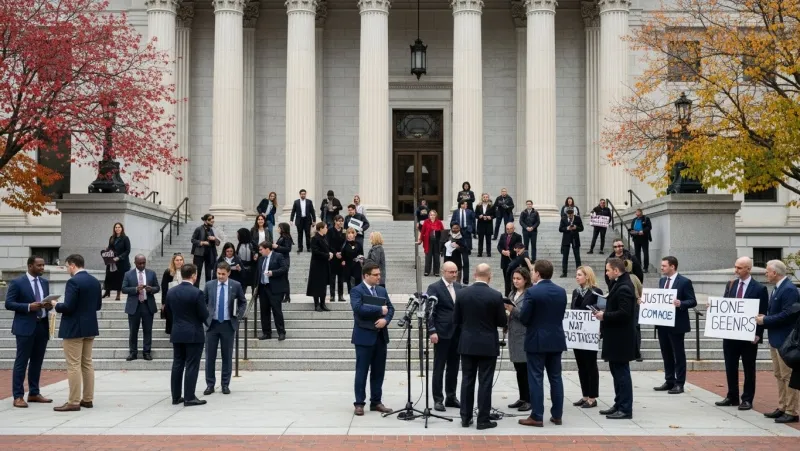
Facing a business dispute in Bakersfield?
30-90 days to resolution. No lawyer needed.





Facing a Business Dispute in Bakersfield? Prepare for Arbitration in 30-90 Days with Confidence
BMA is a legal tech platform providing self-represented parties with the document preparation and local court data needed to manage California arbitrations independently.
This content is for informational purposes only and does not constitute legal advice. Consult a licensed California attorney for guidance specific to your situation.
Why Your Case Is Stronger Than You Think
Many small business owners and consumers in Bakersfield underestimate their leverage when initiating arbitration. Under the California Arbitration Act (California Code of Civil Procedure §1280, et seq.), parties who execute valid arbitration clauses possess significant procedural advantages. These clauses often stipulate binding resolution, requiring courts to enforce arbitration agreements unless they are invalid or unconscionable. Properly documenting contractual terms and interactions can shift the contested landscape significantly, especially when evidence—such as signed contracts, correspondence, and transactional records—are meticulously organized. For instance, demonstrating consistent communication that aligns with contractual obligations can establish breach elements more convincingly. Additionally, California law emphasizes that arbitrators rely heavily on comprehensively prepared submissions; neglecting to include key evidence weakens a party’s position. Effective evidence management and detailed statement of claims position claimants more strongly, enabling them to leverage procedural standards and statutory frameworks to their benefit. This approach emphasizes the importance of initial preparation, which can make the difference between a dismissed claim and a successful resolution.
$14,000–$65,000
Avg. full representation
$399
Self-help doc prep
What Bakersfield Residents Are Up Against
Bakersfield’s business environment reflects a robust mix of small enterprises, service providers, and retail operations, many of which face recurring disputes over payments, service quality, and contractual obligations. According to recent enforcement data, Bakersfield courts and arbitration venues have seen over 500 claims annually related to small business disputes, with a significant portion triggering arbitration clauses embedded within commercial agreements. Statewide, California courts report that approximately 60% of arbitration agreements are challenged on procedural or substantive grounds, often leading to delays or dismissals (California Arbitration Act). Local arbitration providers, such as AAA and JAMS, reveal that nearly 40% of cases involve procedural issues like inadequate evidence or missed deadlines—problems exacerbated by limited familiarity with procedural nuances among non-legal participants. Importantly, enforcement of arbitration awards remains consistent, but the path is fraught with pitfalls; unresolved or mismanaged evidence can extend otherwise straightforward cases into well over a year, increasing costs and diminishing recovery prospects. Recognizing these local patterns helps claimants anticipate obstacles, emphasizing the need for strategic preparation.
The Bakersfield Arbitration Process: What Actually Happens
Arbitration in Bakersfield, governed primarily by the California Arbitration Act and specific rules of arbitration providers, proceeds through four key stages:
- Filing the Claim: The claimant submits a written statement of claim, citing contractual provisions and legal grounds, generally within 30 days of dispute recognition. The filing occurs via AAA or JAMS, which provides standardized templates aligned with California procedural requirements (California Code of Civil Procedure §1281.4). The respondent receives the claim within approximately 10 days, initiating the process.
- Response and Preliminary Conference: The respondent files an answer within 15 days, optionally challenging the scope or validity of the arbitration clause. The arbitration provider schedules a preliminary conference within 20-30 days for procedural rulings and case management, setting timelines for evidence exchange.
- Discovery and Evidence Exchange: Parties exchange evidence over 30-60 days, adhering to deadlines set during the preliminary conference. Evidence includes contracts, correspondence, invoices, and financial records, authenticated per California Evidence Code §1400. Timely and organized submission improves the chances of influence during hearings (California Evidence Code, §§ 1400-1420).
- Hearing and Decision: Hearings typically occur 60-90 days after discovery completion, in person or remotely, depending on provider rules. Arbitrators review submissions, hear witness testimony, and issue a binding award usually within 30 days after the hearing, pursuant to the arbitration provider’s timeline. Enforceability of the award aligns with California law, allowing parties to seek court enforcement if necessary (California Arbitration Act §1285).
Throughout these stages, strict adherence to procedural rules and deadlines—whether set by the arbitration provider or contractual agreement—is crucial to prevent dismissals or adverse rulings. Local practices in Bakersfield mirror statewide procedures but require heightened attention to detail due to case volume and resource limitations.
Your Evidence Checklist

- Contract Documents: Signed agreements, amendments, and related correspondence, ideally in digital format with metadata preserved. Deadline for submission: at the start of arbitration or as specified in rules (usually before or during the discovery phase).
- Communication Records: Emails, text messages, and written notices exchanged with the opposing party, authenticated via CA Evidence Code §1400. These substantiate breach claims and timelines.
- Financial Documentation: Invoices, payment records, receipts, and related financial statements that demonstrate damages or breach effects. Should be organized in chronological order with clear annotations.
- Photographs and Digital Evidence: If applicable, photos or videos illustrating service deficiencies, product defects, or other relevant conditions. Must be authenticated and chain-of-custody maintained.
- Witness Statements and Expert Reports: Affidavits or reports supporting factual or technical claims, submitted within discovery timelines. Witness contact info and sworn declarations should be prepared beforehand.
Most claimants forget to secure authenticated copies of correspondence and to schedule evidence collection within deadlines. Failing to do so risks their inadmissibility or outright rejection during arbitration, lowering the chance for a favorable outcome.
Ready to File Your Dispute?
BMA prepares your arbitration case in 30-90 days. No lawyer needed.
Start Your Case — $399The initial failure manifested through the overlooked discrepancies in the arbitration packet readiness controls, which, despite a superficially complete checklist, concealed significant evidentiary gaps in the contractual exhibits. These gaps silently eroded the validity of key testimony before any review signaled inconsistencies—allowing the evidentiary integrity to deteriorate undetected until the arbitration hearing began. The primary workflow constraint was an overreliance on static document intake governance rather than continuous chain-of-custody discipline, which was cost-prohibitive given the volume of exchanged materials but essential in hindsight. Upon discovering the irreversible absence of multiple original signed amendments, the case momentum halted as attempts to retrofit the record faltered under procedural rigidity and the Bakersfield arbitration panel’s strict evidentiary standards, contributing to a losing position that could not be remediated with supplemental testimony alone. Operationally, this failure underscored the danger of trade-offs between cost containment and thoroughness, particularly in complex business dispute arbitration in Bakersfield, California 93306, where local arbitration preferences demand impeccable documentary continuity.
This is a hypothetical example; we do not name companies, claimants, respondents, or institutions as examples.
- False documentation assumption: Trusting that all required contractual exhibits were included simply because the checklist was marked complete.
- What broke first: Arbitration packet readiness controls—initial document review missed unsigned and missing amendments silently failing evidentiary linkage.
- Generalized documentation lesson tied back to business dispute arbitration in Bakersfield, California 93306: Continuous and dynamic chain-of-custody discipline is critical versus static intake protocols when facing local arbitration evidentiary rigor.
⚠ HYPOTHETICAL CASE STUDY — FOR ILLUSTRATIVE PURPOSES ONLY
Unique Insight Derived From the "business dispute arbitration in Bakersfield, California 93306" Constraints

The Bakersfield arbitration environment imposes particular constraints on evidence submission, where the arbitration panels require not only completeness but demonstrable authenticity and origin verification. This means that seemingly minor deviations in document handling or version management can cascade into severe evidentiary deficiencies that no supplemental affidavits or testimonies can repair. The cost implication pushes teams to balance resource-intensive chain-of-custody measures with timely preparation, often risking silent failures at scale.
Most public guidance tends to omit nuanced considerations around local arbitration preferences, such as Bakersfield's specific preference for original signed documents over electronically scanned versions or third-party attestations. This gap in standard practice guidance leads to misaligned expectations and workflow designs that falter at critical junctures.
Furthermore, trade-offs become apparent where teams prioritize volume over verification due to deadline pressure, which paradoxically increases rework costs and jeopardizes case integrity. The emphasis shifts from simple completion to active readiness, demanding ongoing document vetting rather than front-loaded batch review.
| EEAT Test | What most teams do | What an expert does differently (under evidentiary pressure) |
|---|---|---|
| So What Factor | Check completeness of submission without cross-checking source authenticity. | Establish real-time chain-of-custody logs to document provenance and handling chronology. |
| Evidence of Origin | Rely on scanned copies of signatures without original document validation. | Insist on original signed amendments or notarized attestations compliant with Bakersfield arbitration standards. |
| Unique Delta / Information Gain | Presume intake checklist finality as evidence correctness. | Embed continuous document integrity checkpoints integrated with arbitration packet readiness controls. |
Don't Leave Money on the Table
Full legal representation typically costs $14,000–$65,000 on average. Self-help document prep: $399.
Start Your Case — $399FAQ
Is arbitration binding in California?
Yes, under the California Arbitration Act (California Civil Procedure §1281), binding arbitration agreements enforceable unless challenged on grounds like unconscionability or procedural defects.
How long does arbitration take in Bakersfield?
Typically, arbitration in Bakersfield spans 3 to 6 months from filing to award, provided procedural timelines are strictly followed and no extensions or challenges occur. Complex cases may extend beyond this range.
Can I challenge an arbitration award in California courts?
Yes. Under California Law, parties can seek to vacate or modify an arbitration award based on misconduct, arbitrator bias, or procedural irregularities, as outlined in California Arbitration Act §§ 1286-1288.7.
What if the other party refuses to participate in arbitration?
If the opposing party defaults or refuses, the claimant can request the arbitrator to proceed ex parte and issue an award in their favor, enforced similarly to court judgments, per AAA or JAMS rules.
Why Consumer Disputes Hit Bakersfield Residents Hard
Consumers in Bakersfield earning $83,411/year can't absorb $14K+ in legal costs to fight a company that wronged them. That cost-barrier is exactly what corporations count on — and arbitration at $399 eliminates it.
In Los Angeles County, where 9,936,690 residents earn a median household income of $83,411, the cost of traditional litigation ($14,000–$65,000) represents 17% of a household's annual income. Federal records show 290 Department of Labor wage enforcement cases in this area, with $1,649,743 in back wages recovered for 2,276 affected workers — evidence that businesses here have a pattern of cutting corners on obligations.
$83,411
Median Income
290
DOL Wage Cases
$1,649,743
Back Wages Owed
6.97%
Unemployment
Source: U.S. Census Bureau ACS, IRS SOI, Department of Labor WHD. 31,020 tax filers in ZIP 93306 report an average AGI of $60,110.
PRODUCT SPECIALIST
Content reviewed for procedural accuracy by California-licensed arbitration professionals.
About Jack Adams

View author profile on BMA Law | LinkedIn | Federal Court Records
Arbitration Help Near Bakersfield
Nearby ZIP Codes:
Arbitration Resources Near
If your dispute in involves a different issue, explore: Employment Dispute arbitration in • Contract Dispute arbitration in • Business Dispute arbitration in • Insurance Dispute arbitration in
Nearby arbitration cases: Ione consumer dispute arbitration • Mcclellan consumer dispute arbitration • Coronado consumer dispute arbitration • Newhall consumer dispute arbitration • Oceanside consumer dispute arbitration
Other ZIP codes in :
References
California Arbitration Act: https://leginfo.legislature.ca.gov/faces/codes_displayText.xhtml?lawCode=CIV&division=3.&title=9.&chapter=6
California Code of Civil Procedure (Procedural deadlines): https://leginfo.legislature.ca.gov/faces/codes_displayText.xhtml?lawCode=CCP
AAA Rules: https://www.adr.org/Rules
California Evidence Code: https://leginfo.legislature.ca.gov/faces/codes_displayText.xhtml?lawCode=EVID
Local Economic Profile: Bakersfield, California
$60,110
Avg Income (IRS)
290
DOL Wage Cases
$1,649,743
Back Wages Owed
Federal records show 290 Department of Labor wage enforcement cases in this area, with $1,649,743 in back wages recovered for 2,518 affected workers. 31,020 tax filers in ZIP 93306 report an average adjusted gross income of $60,110.

