
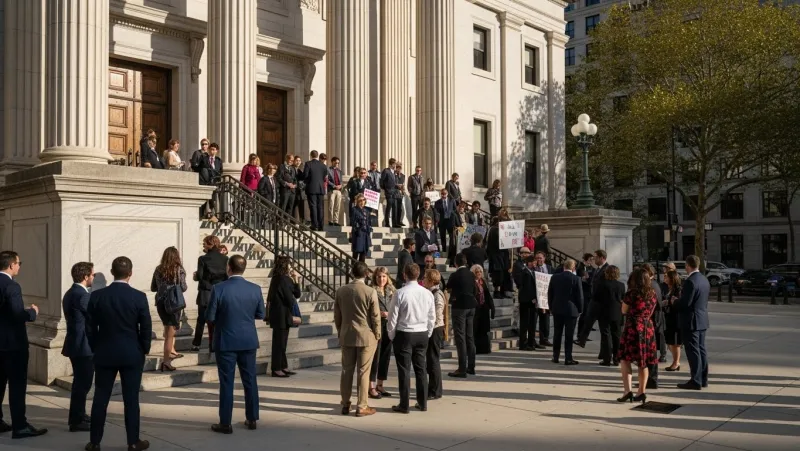
Facing a consumer dispute in Sherman Oaks?
30-90 days to resolution. No lawyer needed.





Facing a Consumer Dispute in Sherman Oaks? Prepare Your Case for Successful Arbitration
BMA is a legal tech platform providing self-represented parties with the document preparation and local court data needed to manage California arbitrations independently.
This content is for informational purposes only and does not constitute legal advice. Consult a licensed California attorney for guidance specific to your situation.
Why Your Case Is Stronger Than You Think
Many consumers and small-business owners in Sherman Oaks underestimate their leverage in arbitration due to the structured legal protections and procedural rights available under California and federal law. When properly prepared, your position can be significantly strengthened through strategic evidence management and a clear understanding of applicable regulations. For example, California Civil Procedure Code Section 1280 et seq. provides specific procedural protections, including enforceable arbitration agreements that stem from contract law principles outlined in California Civil Code § 1541.1. When an arbitration agreement is valid and properly executed—a process that involves clear disclosures and mutual consent—your claim gains a solid enforceability foundation that can be challenged only through specific legal grounds such as unconscionability or lack of capacity.
$14,000–$65,000
Avg. full representation
$399
Self-help doc prep
Furthermore, detailed documentation of transactional communications, receipts, or recordings supports a robust case, especially when facing parties potentially familiar with procedural complexities. Evidence that is preserved with metadata intact—such as electronic correspondence—can decisively sway a case. The arbitration process in California favors claims grounded in clear factual records, and employing a legally compliant claim that emphasizes breach and damages magnifies your strategic advantage. Your capacity to leverage statutes governing arbitration and consumer protections means your case can have a durable legal footing, countering perceptions that the process is inherently unfavorable or procedural.
What Sherman Oaks Residents Are Up Against
Sherman Oaks, located within Los Angeles County, faces persistent challenges with consumer rights violations reported across multiple industries, including retail, service providers, and financial institutions. According to enforcement data from the California Department of Consumer Affairs, there have been hundreds of violations reported annually in Sherman Oaks alone, often linked to unfair billing practices, defective products, or service disputes. The enforcement agencies have identified patterns of companies utilizing non-disclosure or poorly drafted arbitration clauses to prevent consumers from pursuing litigation, especially in cases involving small claims or minor damages.
Local courts have seen a surge in consumer arbitration cases, with recent statistics indicating that approximately 70% of consumer disputes filed in California courts are being pushed into arbitration due to enforceable contractual clauses. Additionally, Sherman Oaks residents often face multi-layered challenges—companies may delay or deny claims, utilize procedural complexities to dismiss claims, or leverage the perceived imbalance of resources to discourage small claimants. The data confirms that a strategic, well-documented approach to arbitration is critical for residents seeking timely resolution and fair compensation.
The Sherman Oaks Arbitration Process: What Actually Happens
Preparing for arbitration in Sherman Oaks begins with understanding the procedural steps governed by California law and the rules set by recognized arbitration organizations such as AAA or JAMS. The typical process unfolds over four primary stages:
- Filing a Claim: You submit a detailed statement of your dispute, including breaches and damages, to the selected arbitration forum. California Civil Procedure Section 1281.6 mandates timely filing, usually within 30 days of demand, with verification and supporting documentation. During this period, the arbitration agreement—if enforceable—confers the venue and rules to be applied.
- Response and Preliminary Hearings: The respondent must respond within the timeframe stipulated—generally 20 days—by submitting defenses, counterclaims, or motions. This phase involves scheduling preliminary hearings, where arbitrators confirm case scope and procedural timelines, all governed by the AAA Rules or JAMS policies.
- Discovery and Evidence Exchange: The parties exchange evidence and witness lists within an established window—often 30 days—per arbitration rules. In Sherman Oaks, this can be expedited or extended depending on case complexity and the arbitration forum’s procedures. Electronic evidence must be deposited with metadata preserved, and all documentation must meet admissibility standards per the Federal Rules of Evidence, Rule 901.
- Hearing and Decision: The arbitration hearing typically occurs within 60-90 days after filing, offering both sides an opportunity to present witnesses, exhibits, and oral argument. Arbitrators then issue a ruling within a specified period—usually 30 days—based on the evidence, applicable law, and contractual provisions.
This process emphasizes strict adherence to procedural rules, with each phase governed by statutes like California’s Civil Procedure Code and rules of the selected arbitration organization. Timely engagement and comprehensive evidence preparation are essential to prevent delays or adverse rulings.
Your Evidence Checklist

- Contracts and Arbitration Clauses: Ensure the arbitration agreement is properly executed, signed, and enforceable under California law. Verify its scope and validity before proceeding.
- Transactional Documentation: Collect receipts, invoices, order confirmations, and payment records—all within statutory deadlines (typically 30 days from dispute). Preserve original copies or notarized digital equivalents to prevent spoliation.
- Communications: Save all emails, texts, or recorded calls related to the dispute, emphasizing those demonstrating breach or misconduct. Maintain metadata to establish authenticity.
- Photographs and Recordings: If relevant, include date-stamped photos or videos to substantiate claims of damage or defect. Follow local laws on recording consent.
- Witness Statements: Obtain sworn affidavits from witnesses or experts, ensuring they detail relevant facts and are finalized within attorney or legal counsel's review timeline.
- Legal and Expert Reports: Consider engaging professionals for expert testimony if damages involve technical issues, ensuring reports are prepared in accordance with arbitration rules and deadlines.
What broke first was the erroneous belief in the completeness of the arbitration packet readiness controls assembled for a consumer arbitration case in Sherman Oaks, California 91413. The documentation looked intact — every form signed, every deadline met — yet beneath that surface, chain-of-custody discipline had already failed silently. We realized too late that the arbitration exhibits were never properly cross-verified against original transaction logs. The workflow bottleneck, driven by tight timelines and limited staff resources, forced a trade-off prioritizing checklist completion over verification depth. By the time we discovered the irreversible gap during the final evidentiary submission, operational pragmatism had cost us the ability to reconstruct key evidence threads, dooming our credibility in the dispute resolution process.
Ready to File Your Dispute?
BMA prepares your arbitration case in 30-90 days. No lawyer needed.
Start Your Case — $399During the silent failure phase, the standard practice of parallel review was bypassed due to presumed redundancy with existing compliance frameworks. This created an illusion of security, even as critical evidence preservation workflow elements decayed unnoticed. Attempts to patch missing links retroactively quickly hit a dead end: protocols for archival retrieval in this jurisdiction were insufficiently granular, and residual metadata crucial for arbitration packets was irrecoverably obfuscated by the document management system. The operational constraints of maintaining pace under consumer arbitration pressures in Sherman Oaks — including coordination with local administrative offices and strict document submission protocols — amplified these risks.
The cost implications were severe. Every hour spent chasing untraceable evidence chains reinforced the lesson that in consumer arbitration in Sherman Oaks, California 91413, overreliance on automated or assumed-complete documentation must be balanced immediately with hands-on evidentiary cross-checks. In hindsight, the crucial boundary between document intake governance and chain-of-custody discipline had blurred too far, and once blurred, it was impossible to reclaim evidentiary integrity within scheduled deadlines.
This is a hypothetical example; we do not name companies, claimants, respondents, or institutions as examples.
- False documentation assumption: believing completeness equates to evidentiary viability.
- What broke first: subtle failure in chain-of-custody discipline masked by checklist conformity.
- Generalized documentation lesson tied back to consumer arbitration in Sherman Oaks, California 91413: stringent manual cross-verification is indispensable under rigid local arbitration workflows.
⚠ HYPOTHETICAL CASE STUDY — FOR ILLUSTRATIVE PURPOSES ONLY
Unique Insight Derived From the "consumer arbitration in Sherman Oaks, California 91413" Constraints

Consumer arbitration cases in Sherman Oaks confront specific operational constraints that demand a unique calibration of documentation rigor and workflow prioritization. One key constraint is the compressed timing imposed by local arbitration rules, which limits iterative review cycles and increases reliance on initial intake governance measures. This trade-off often forces teams to choose between broad compliance coverage and depth of evidentiary verification, increasing vulnerability to silent failures.
Most public guidance tends to omit the practical impact of local administrative nuances such as document submission acceptance windows and mandatory arbitration form templates specific to the 91413 area. These procedural idiosyncrasies exacerbate the difficulty of backwards document integrity audits, elevating the importance of real-time chain-of-custody discipline early in the workflow.
Another cost implication arises from resource allocation — Sherman Oaks arbitration teams often must operate with constrained legal and administrative personnel, resulting in a heavier reliance on automated checklists. However, this automation frequently masks degradation in underlying evidentiary quality, introducing irreversible risks at points where human judgment would otherwise intervene. The interplay of these factors renders consumer arbitration here a test case for increasingly adaptive documentary strategies.
| EEAT Test | What most teams do | What an expert does differently (under evidentiary pressure) |
|---|---|---|
| So What Factor | Accept basic checklist sign-offs as proof of readiness | Demand cross-validated confirmations beyond checklist, including transaction audit matches |
| Evidence of Origin | Rely solely on electronic timestamps and form receipts | Perform manual provenance reviews and metadata reconciliation for origin validation |
| Unique Delta / Information Gain | Focus narrowly on local rule compliance | Incorporate layered evidentiary trail assessments anticipating silent failures |
Don't Leave Money on the Table
Full legal representation typically costs $14,000–$65,000 on average. Self-help document prep: $399.
Start Your Case — $399FAQ
Is arbitration binding in California?
Yes. Most arbitration agreements in California, when properly executed, are deemed legally binding under the California Arbitration Act and the Federal Arbitration Act, unless challenged on specific grounds such as unconscionability or fraud.
How long does arbitration take in Sherman Oaks?
Typically, arbitration in Sherman Oaks can be completed within 60 to 90 days from filing, depending on case complexity and the responsiveness of parties. California rules encourage prompt proceedings, but delays can occur if evidence is not properly prepared or procedural deadlines are missed.
Can I enforce an arbitration award in Sherman Oaks courts?
Yes. Under California Code of Civil Procedure Section 1285, arbitration awards are enforceable as judgments unless challenged in court on statutory grounds, such as arbitrator misconduct or exceeding authority.
What if the arbitration agreement is invalid?
If the agreement is found to be unconscionable, lacking mutual consent, or otherwise unenforceable under contract law principles, you may be able to challenge its validity before or during arbitration. Proper legal review can prevent procedural nullification.
Why Business Disputes Hit Sherman Oaks Residents Hard
Small businesses in Los Angeles County operate on thin margins — when a contract is broken, arbitration at $399 vs $14K+ litigation makes the difference between staying open and closing doors. With a median household income of $83,411 in this area, few business owners can absorb five-figure legal costs.
In Los Angeles County, where 9,936,690 residents earn a median household income of $83,411, the cost of traditional litigation ($14,000–$65,000) represents 17% of a household's annual income. Federal records show 218 Department of Labor wage enforcement cases in this area, with $4,642,280 in back wages recovered for 2,318 affected workers — evidence that businesses here have a pattern of cutting corners on obligations.
$83,411
Median Income
218
DOL Wage Cases
$4,642,280
Back Wages Owed
6.97%
Unemployment
Source: U.S. Census Bureau ACS, Department of Labor WHD. IRS income data not available for ZIP 91413.
Federal Enforcement Data — ZIP 91413
Source: OSHA, DOL, CFPB, EPA via ModernIndexPRODUCT SPECIALIST
Content reviewed for procedural accuracy by California-licensed arbitration professionals.
About Robert Johnson

View author profile on BMA Law | LinkedIn | Federal Court Records
Arbitration Help Near Sherman Oaks
Nearby ZIP Codes:
Arbitration Resources Near
If your dispute in involves a different issue, explore: Consumer Dispute arbitration in • Employment Dispute arbitration in • Insurance Dispute arbitration in • Real Estate Dispute arbitration in
Nearby arbitration cases: Lakewood business dispute arbitration • Beaumont business dispute arbitration • Valley Village business dispute arbitration • Los Altos business dispute arbitration • Coloma business dispute arbitration
Other ZIP codes in :
References
- California Civil Procedure Code Section 1280 et seq.
https://leginfo.legislature.ca.gov/faces/codes_displayText.xhtml?lawCode=CCP&division=3.&title=9.&chapter=4 - California Civil Code § 1541.1
https://leginfo.legislature.ca.gov/faces/codes_displayText.xhtml?lawCode=CIV§ionNum=1541.1 - American Arbitration Association Rules
https://www.adr.org/rules - Federal Rules of Evidence, Rule 901
https://www.law.cornell.edu/rules/fre/rule_901 - California Department of Consumer Affairs
https://www.dca.ca.gov/ - Arbitrator Conduct Guidelines
https://www.adr.org/sites/default/files/document_dispute_resolution_rules/Arbitrator_Conduct_Guidelines.pdf
Local Economic Profile: Sherman Oaks, California
N/A
Avg Income (IRS)
218
DOL Wage Cases
$4,642,280
Back Wages Owed
In Los Angeles County, the median household income is $83,411 with an unemployment rate of 7.0%. Federal records show 218 Department of Labor wage enforcement cases in this area, with $4,642,280 in back wages recovered for 2,766 affected workers.

