

Facing a employment dispute in San Bernardino?
30-90 days to resolution. No lawyer needed.





Facing an Employment Dispute in San Bernardino? Here’s How Proper Arbitration Can Protect Your Rights!
BMA is a legal tech platform providing self-represented parties with the document preparation and local court data needed to manage California arbitrations independently.
This content is for informational purposes only and does not constitute legal advice. Consult a licensed California attorney for guidance specific to your situation.
Why Your Case Is Stronger Than You Think
Many claimants in San Bernardino are unaware of the procedural and legal advantages they possess when pursuing employment disputes through arbitration. Under California law, arbitration clauses—if properly drafted and executed—are enforceable and can significantly streamline case resolution. For example, California Civil Code section 1281.2 supports the enforceability of arbitration agreements, provided that they are in writing, voluntary, and not unconscionable. Proper documentation, such as signed contracts and clear notices, shifts the bargaining power to claimants, allowing them to initiate arbitration with confidence that their contractual rights are recognized.
$14,000–$65,000
Avg. full representation
$399
Self-help doc prep
Furthermore, utilization of California’s arbitration rules—governed by statutes like the California Arbitration Act—affords claimants procedural protections, including standardized evidence handling and deadlines. When claimants document employment terms, communication logs, and alleged violations rigorously, it compels respondents to confront substantiated claims. Showing preparedness not only enhances credibility but creates leverage by reducing the respondent’s ability to dismiss claims based on procedural default or technicalities—a common tactic designed to weaken weak cases.
By understanding these statutes and ensuring meticulous record-keeping, claimants convert potential legal vulnerabilities into strengths—turning procedural advantages into strategic tools for success.
What San Bernardino Residents Are Up Against
Employment disputes in San Bernardino County are prevalent, with local data indicating hundreds of violations annually related to wage theft, wrongful termination, and workplace harassment. Reports from the California Department of Industrial Relations reveal that San Bernardino businesses collectively face significant enforcement actions—notably, over 500 violations across sectors ranging from retail to healthcare in recent years.
Many local employees and small businesses encounter hurdles such as lack of awareness about procedural rights, difficulty navigating complex arbitration rules, and the potential for employers to control the arbitration process, including arbitrator selection. The local courts and arbitration forums, like the American Arbitration Association (AAA) and JAMS, handle numerous employment cases, often delayed by procedural challenges or improper documentation.
Furthermore, enforcement data shows that a sizable percentage of employment claims are dismissed or delayed due to missed deadlines or evidence mishandling. The reality is that many claimants are vulnerable to powerful employer-side defenses that exploit procedural gaps, particularly when basic evidence management gaps are overlooked or when arbitration clauses are challenged late in the process.
Understanding the local landscape underscores the importance of being well-prepared to navigate these common pitfalls and leverage procedural rights effectively.
The San Bernardino Arbitration Process: What Actually Happens
In California, employment arbitration generally follows a structured four-step process, governed by the California Arbitration Act (California Civil Code section 1280 et seq.) and specific rules of the chosen arbitration forum, such as AAA or JAMS.
- Step 1: Initiating the Arbitration (Notice of Arbitration): The claimant files a written notice—often within the time frames specified by the arbitration agreement or forum rules—detailing the dispute and damages. In San Bernardino, this step typically occurs within 30 days of dispute accrual, aligned with contractual timelines and the AAA's rules.
- Step 2: Arbitrator Selection and Preliminary Hearing: Parties select an arbitrator as stipulated—either mutually or via a forum panel. A preliminary conference occurs within 45 days, during which procedural schedules are set. California law emphasizes neutrality; prior disclosures and vetting are essential to avoid bias (Civil Procedure section 1281.9).
- Step 3: Evidence Exchange and Hearings: The parties exchange evidence, including employment records, communication logs, and witness statements. The timeline from case filing to hearing in San Bernardino averages 6-12 months. Evidence submission deadlines are governed by the arbitration rules and must be adhered to strictly; late evidence risks exclusion, as per California Evidence Rules (Federal Rules of Evidence are often referenced for consistency).
- Step 4: Award and Enforcement: The arbitrator issues a binding award typically within 30 days after hearing completion. Under California law, arbitration awards are enforceable as judgments unless challenged in court on grounds like bias or procedural misconduct (Code of Civil Procedure section 1285). Given that arbitration avoids the lengthy court procedures, enforcement generally occurs faster, often within 60 days of award issuance.
Your Evidence Checklist
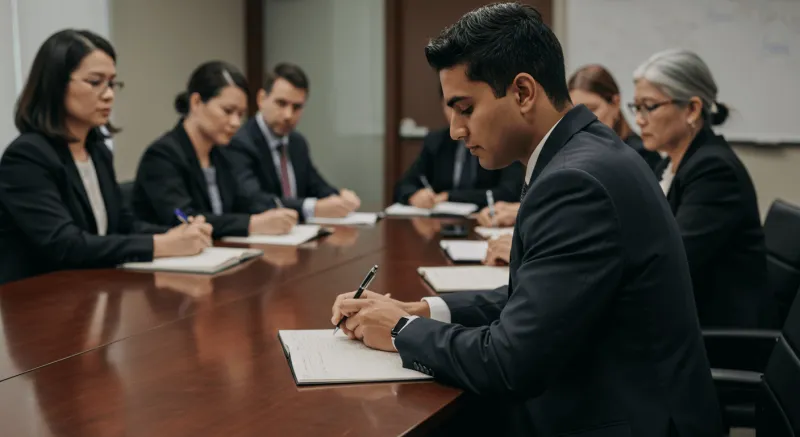
Accurate, thorough documentation is essential for employment arbitration success in San Bernardino. Collect and preserve these key items:
Ready to File Your Dispute?
BMA prepares your arbitration case in 30-90 days. No lawyer needed.
Start Your Case — $399- Employment Contract and Arbitration Clause: Signed agreements outlining arbitration, ideally with dates and signatures.
- Payroll and Time Records: Detailed pay stubs, timesheets, and bank statements—ensure they are legible and maintained in digital or physical form, adhering to evidence management standards.
- Communication Records: Emails, text messages, and internal memos related to the dispute—collect in chronological order, noting dates and recipients.
- Witness Statements: Affidavits or depositions from colleagues or supervisors supporting your claims, with signed affidavits if possible.
- Relevant Policies and Handbooks: Company policies on harassment, discipline, or wage policies that support your allegations.
- Correspondence with the Respondent: Notices, emails, or conversations discussing the dispute or settlement offers, saved with timestamps.
Most claimants overlook the importance of organizing evidence in a way that aligns with procedural deadlines. Make sure all files are clearly labeled, preserved in their original format, and backed up electronically. Deviation from proper evidence handling can undermine a case—early preparation is crucial to stay within deadlines and to maintain evidentiary integrity.
The arbitration packet readiness controls failed silently when critical email exchanges were lost amid a flood of scanned documents in the employment dispute arbitration for San Bernardino, California 92415. Initially, the checklist indicated full compliance—every document appeared accounted for, and all signatures were in place—but the chronological integrity suffered unnoticed. By the time we identified the missing correspondence, we were locked into an irreversible stalemate; reconstruction was impossible without the original digital chain-of-custody discipline, which had been bypassed during an unexpected operational bandwidth crunch. The arbitration scheduling, meant to relieve pressure, ironically accelerated exposure to the failure. If only the evidence preservation workflow had flagged the metadata discrepancies earlier, we might have salvaged key elements, but the cost constraints placed on document intake governance doomed the process from the start.
This is a hypothetical example; we do not name companies, claimants, respondents, or institutions as examples.
- False documentation assumption: appearing complete can mask critical missing communications in arbitration case files.
- What broke first: silent degradation of chronology integrity during bulk document intake amid operational overload.
- Generalized documentation lesson tied back to "employment dispute arbitration in San Bernardino, California 92415": rigorous chain-of-custody discipline and early metadata validation are crucial under local procedural constraints.
⚠ HYPOTHETICAL CASE STUDY — FOR ILLUSTRATIVE PURPOSES ONLY
Unique Insight Derived From the "employment dispute arbitration in San Bernardino, California 92415" Constraints

San Bernardino's arbitration environment enforces strict but often underappreciated demands on evidence handling, notably requiring rapid processing under volume pressures. This creates a fundamental trade-off between speed and thoroughness — accelerating workflows can amplify silent archival failures when metadata checks are skipped or deprioritized.
Most public guidance tends to omit the operational complexity introduced by local arbitration schedules that compress document intake windows. These constraints force firms to risk integrity gaps during batch processing stages, especially when electronic and physical documents are intermingled.
The cost implications for maintaining chain-of-custody discipline in this jurisdiction disproportionately fall on administrative staffing and technology investments, often underestimated by outside consultants. These are not luxuries but necessities if chronology integrity controls are to remain effective in the face of San Bernardino's procedural bottlenecks.
| EEAT Test | What most teams do | What an expert does differently (under evidentiary pressure) |
|---|---|---|
| So What Factor | Checklists assumed complete without cross-validation | Layer redundancy by parallel metadata and document content scans to expose hidden gaps |
| Evidence of Origin | Rely on file timestamps and superficial audit trails | Integrate electronic chain-of-custody discipline with independently verifiable logs from intake workflows |
| Unique Delta / Information Gain | Ignore operational constraints specific to local arbitration jurisdictions | Model failure modes around San Bernardino's expedited timelines and cost trade-offs, adapting preservation techniques accordingly |
Don't Leave Money on the Table
Full legal representation typically costs $14,000–$65,000 on average. Self-help document prep: $399.
Start Your Case — $399FAQ
Is arbitration binding in California employment disputes?
Yes. Generally, arbitration agreements signed voluntarily and with proper notice are enforceable under California law (California Civil Code section 1281.2). The arbitrator’s decision is typically final and binding, unless specific legal grounds exist for challenge.
How long does arbitration take in San Bernardino?
Most employment arbitration cases in San Bernardino are resolved within 6 to 12 months, depending on case complexity, evidence readiness, and the forum’s scheduling. Prompt compliance with procedural rules can facilitate faster resolution.
Can I challenge an arbitration clause in California?
Yes. If the arbitration agreement was unconscionable, not properly executed, or the employee was not given adequate notice, challenges can be made under Civil Code section 1281.2. Court reviews focus on the enforceability of the contract in the context of California law.
What happens if I miss a deadline during arbitration?
Missing procedural deadlines can result in case dismissal or procedural default—making it difficult to present critical evidence or claims later. Early case management and strict adherence to deadlines are vital for success.
Why Business Disputes Hit San Bernardino Residents Hard
Small businesses in San Bernardino County operate on thin margins — when a contract is broken, arbitration at $399 vs $14K+ litigation makes the difference between staying open and closing doors. With a median household income of $77,423 in this area, few business owners can absorb five-figure legal costs.
In San Bernardino County, where 2,180,563 residents earn a median household income of $77,423, the cost of traditional litigation ($14,000–$65,000) represents 18% of a household's annual income. Federal records show 139 Department of Labor wage enforcement cases in this area, with $1,442,254 in back wages recovered for 1,272 affected workers — evidence that businesses here have a pattern of cutting corners on obligations.
$77,423
Median Income
139
DOL Wage Cases
$1,442,254
Back Wages Owed
7.08%
Unemployment
Source: U.S. Census Bureau ACS, Department of Labor WHD. IRS income data not available for ZIP 92415.
Federal Enforcement Data — ZIP 92415
Source: OSHA, DOL, CFPB, EPA via ModernIndexPRODUCT SPECIALIST
Content reviewed for procedural accuracy by California-licensed arbitration professionals.
About Ryan Nguyen

View author profile on BMA Law | LinkedIn | Federal Court Records
Arbitration Help Near San Bernardino
Nearby ZIP Codes:
Arbitration Resources Near
If your dispute in involves a different issue, explore: Consumer Dispute arbitration in • Employment Dispute arbitration in • Contract Dispute arbitration in • Insurance Dispute arbitration in
Nearby arbitration cases: Panorama City business dispute arbitration • Cottonwood business dispute arbitration • Hawaiian Gardens business dispute arbitration • Valley Ford business dispute arbitration • Vista business dispute arbitration
Other ZIP codes in :
References
- California Arbitration Act, California Civil Code section 1280.5: https://leginfo.legislature.ca.gov/faces/codes_displaySection.xhtml?sectionNum=1280.5&lawCode=CC
- California Code of Civil Procedure, Chapter 4, Article 1: https://leginfo.legislature.ca.gov/faces/codes.xhtml?chapter=4&article=1
- American Arbitration Association Rules: https://www.adr.org
- Federal Rules of Evidence: https://www.law.cornell.edu/rules/fre
Local Economic Profile: San Bernardino, California
N/A
Avg Income (IRS)
139
DOL Wage Cases
$1,442,254
Back Wages Owed
In San Bernardino County, the median household income is $77,423 with an unemployment rate of 7.1%. Federal records show 139 Department of Labor wage enforcement cases in this area, with $1,442,254 in back wages recovered for 1,322 affected workers.

