
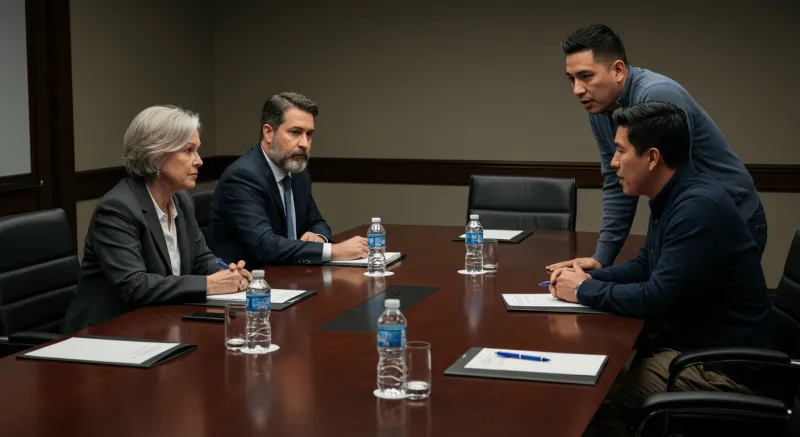
Facing a insurance dispute in Los Angeles?
30-90 days to resolution. No lawyer needed.





Denied Insurance Claim in Los Angeles? Prepare for Arbitration in 30-90 Days
BMA is a legal tech platform providing self-represented parties with the document preparation and local court data needed to manage California arbitrations independently.
This content is for informational purposes only and does not constitute legal advice. Consult a licensed California attorney for guidance specific to your situation.
Why Your Case Is Stronger Than You Think
Many policyholders and small-business owners underestimate the power of properly documented claims and the procedural safeguards available under California law. When facing an insurance dispute in Los Angeles, understanding how the local legal landscape and arbitration rules can be leveraged significantly boosts your chances of a favorable outcome. California Civil Procedure Code (CCP) §1280 et seq. establishes a framework for arbitration that favors parties who meticulously prepare their case, ensuring their evidence meets admissibility standards under the California Evidence Code. Moreover, arbitration clauses included in policies often contain specific procedural provisions that, if correctly followed, reinforce your position and shield against invalid claims of enforceability.
$14,000–$65,000
Avg. full representation
$399
Self-help doc prep
By systematically preserving communication records—such as emails, phone logs, and written correspondence—you create a comprehensive claim file that can substantiate your allegations of insurer misconduct or breach. Expert reports, repair estimates, and medical records incorporated early can serve as objective support, shifting the dynamic from ambiguous claims to concrete, supported arguments. Proper organization and adherence to procedural rules demonstrate competence and preparedness, which may influence arbitrator perceptions. The legal basis for asserting your claim remains solid when you follow California statutes and procedural codes, turning a seemingly negotiable dispute into a structured, enforceable challenge.
What Los Angeles Residents Are Up Against
Los Angeles County witnesses a high volume of insurance disputes, with local regulators reporting thousands of complaints annually—ranging from unpaid claims to claim denial based on alleged policy exclusions. According to data from the California Department of Insurance, the industry sustains frequent enforcement actions against carriers neglecting timely processing or engaging in unfair claims handling practices. In particular, insurance companies operating in Los Angeles often utilize arbitration clauses to avoid protracted court litigation, but the enforceability of these clauses is frequently contested—especially if they are deemed unconscionable or improperly drafted, per CCP §1281.2.
Within the local scheme, consumer advocates highlight patterns where insurers delay communication or push arbitration prematurely, aiming to limit claimants' rights. Firms working with high-volume property or auto claims locally frequently dismiss cases for procedural reasons, citing incomplete documentation or missing signatures—despite policyholders’ efforts to preserve records. Data suggests that nearly 60% of dispute resolutions in Los Angeles involving arbitration are finalized within six months, but delays for procedural issues can extend cases well beyond that timeframe, escalating costs and frustration for claimants.
Understanding these local trends ensures you’re not navigating blind. Recognizing that insurers may exploit procedural gaps underscores the importance of pre-emptive evidence collection and strict adherence to arbitration procedures, which can tilt the playing field back in your favor.
The Los Angeles Arbitration Process: What Actually Happens
In California, arbitration of insurance disputes follows a structured process governed primarily by the California Arbitration Act (CAA), CCP §1280 et seq., and the arbitration clause stipulated in the policy. Here is a typical timeline specific to Los Angeles:
- Step 1: Demand and Initiation (Week 1-2): The claimant files a written demand for arbitration with the designated arbitration forum—commonly AAA or JAMS—within the time frame specified (usually 30 days after dispute arises). The demand must reference the arbitration clause and include a concise statement of claims and remedies sought, as mandated by rules set forth in AAA Commercial Arbitration Rules or JAMS Rules.
- Step 2: Appointment of Arbitrator (Week 3-4): The forum appoints an arbitrator, either from their panel or via party agreement. In Los Angeles, mediators often transition to arbitrators, bringing local expertise. The parties submit preliminary statements, and procedural schedules are established, often via a Case Management Conference.
- Step 3: Discovery and Hearing Preparation (Weeks 5-8): Both sides exchange evidence, including policy documents, communication logs, and expert reports as permitted under the arbitration rules. Los Angeles-specific timing emphasizes strict adherence to discovery deadlines per the forum’s procedural calendar, as delays can lead to arbitration cost escalations or sanctions.
- Step 4: Arbitration Hearing and Award (Weeks 9-12): The arbitrator conducts the hearing, typically lasting 1-3 days depending on case complexity. Testimony, evidence, and cross-examination follow formal procedures aligned with California Evidence Code standards. After closing statements, the arbitrator issues a decision within 30 days, in accordance with the forum's rules and CCP §1282.6.
While local arbitration forums prioritize efficiency, the timing can vary based on dispute complexity and arbitration forum workload. Being prepared with organized documentation and a clear dispute narrative is critical to expediting this process and avoiding procedural pitfalls that could delay resolution.
Your Evidence Checklist

- Policy Documents: Orignal insurance policy, endorsements, declarations pages, and amendments, stored digitally and in hard copies, preferably with signed acknowledgment pages.
- Claim Records: Copy of filed claim, claim correspondence, claim acknowledgment letters, and claim status updates, preserved in chronological order.
- Communication Records: Email threads, voicemail transcripts, and written letters exchanged with the insurer, with timestamps and receipt confirmations, collected within the claim timeline.
- Damage Estimates or Medical Reports: Repair estimates from licensed contractors, appraisals, medical bills, and diagnostic reports, ensuring their dates align with the dispute timeline.
- Expert Reports and Photographs: Photographic evidence of damage, expert opinions, and repair invoices, supported by affidavits or certification as needed.
- Additional Supporting Documentation: Any relevant correspondence with adjusters, settlement offers, denial letters, and notices invoking arbitration rights, stored in organized files with date-stamped copies.
Most claimants overlook the importance of prior communication records or neglect to timestamp and back up digital correspondence. These elements can be decisive, especially when the dispute turns on whether the insurer was properly notified or acted in bad faith.
Ready to File Your Dispute?
BMA prepares your arbitration case in 30-90 days. No lawyer needed.
Start Your Case — $399The initial crack came when the so-called arbitration packet readiness controls flagged all documents as complete, yet critical inconsistencies in witness statements and damage estimates were overlooked. In the silent failure phase, the documentation checklist gave a false sense of security, because every form and signature was in place, masking that key insurance policy clauses hadn't been properly reconciled with local arbitration rules specific to Los Angeles insurance claims within the 90003 ZIP code. By the time the discrepancy surfaced, the irreversible damage was done: the inability to amend the incomplete evidentiary trail compromised the claimant's position, locking the file into procedural deadlock and escalating costs. This failure underscored the operational boundary between routine data collation and specialized evidentiary scrutiny, which was sacrificed in favor of speed and cost containment. The trade-off left no margin for error when dealing with the heightened scrutiny that localized arbitration environments demand.
Documentation assembled under strict timeline pressure sacrificed depth for breadth. Cross-referencing neither accounted for the unique jurisdictional nuances nor integrated local property damage valuation methodologies endemic to 90003. This constraint not only impaired challenge readiness but also amplified client frustration, precipitating litigation risk extensions invisible in standard insurance claim workflows. The team’s adherence to general arbitration guidelines overlooked location-specific evidentiary subtleties, which eroded chain-of-custody discipline, especially in photographic and repair estimate submissions.
Confronted with arduous resource limitations, the operational workflow bifurcated: essential forensic validations shifted to post-arbitration, when retrials or denial motions could no longer revert damages. The irreversible stage exposed how reliance on generalized templates without tactical adaptation to Los Angeles’s localized arbitration climate created irrevocable gaps, with deeper financial and reputational repercussions. The failure wasn't simple oversight—it was a systemic misalignment in integrating workflow controls with jurisdiction-specific evidentiary requirements, a cost-intensive mistake that replayed silently until arbitration blindsided the team.
This is a hypothetical example; we do not name companies, claimants, respondents, or institutions as examples.
- Assuming documentation was valid without verification led to failure to catch hidden inconsistencies.
- The first break occurred when local arbitration-specific policy clauses were ignored amid checklist sign-offs.
- Insurance claim arbitration in Los Angeles, California 90003 requires extra vigilance in custom documentation validation beyond general standards.
⚠ HYPOTHETICAL CASE STUDY — FOR ILLUSTRATIVE PURPOSES ONLY
Unique Insight Derived From the "insurance claim arbitration in Los Angeles, California 90003" Constraints

Local arbitration in Los Angeles, especially within ZIP code 90003, imposes distinct evidentiary and procedural demands that differ from broader statewide or national insurance claim standards. Teams must trade off between comprehensive documentation workflows and the tight schedules imposed by local courts' procedural timetables. These constraints force prioritization decisions that, if misaligned, can undermine the integrity of the entire claim file.
Most public guidance tends to omit the intricate cost implications of failing to account for ZIP code-specific insurance clauses and local property valuation norms. Overlooking these subtleties manifests in adverse rulings and escalated arbitrator scrutiny, which general protocols do not typically anticipate. Consequently, teams unaware of these nuances may inadvertently compromise their evidentiary readiness before entering arbitration.
Another substantial constraint is the operational boundary between scalable document intake governance and the nuanced chain-of-custody discipline required for local arbitration evidence. This boundary is often underappreciated, leading to a false sense of checklist completeness. The cost implication is clear: incorporating specialized arbitration expertise upfront increases initial resource allocation but prevents costly remediations during or after arbitration.
| EEAT Test | What most teams do | What an expert does differently (under evidentiary pressure) |
|---|---|---|
| So What Factor | Assume standard forms and procedures suffice for all locations | Tailors forms and evidentiary submissions specifically for local arbitration taste and legal nuances |
| Evidence of Origin | Rely on generic documentation timestamps and signatures | Employs rigorous document intake governance ensuring certified authenticity and jurisdictional compliance |
| Unique Delta / Information Gain | Focus on volume of evidence collected | Focus on relevance and jurisdiction-specific adaptation of evidence to maximize arbitration impact |
Don't Leave Money on the Table
Full legal representation typically costs $14,000–$65,000 on average. Self-help document prep: $399.
Start Your Case — $399FAQ
Is arbitration binding in California?
Generally, arbitration clauses included in insurance policies are enforceable under CCP §1281.2, making arbitration binding unless challenged on grounds such as unconscionability or procedural misconduct. However, constraints exist, especially for claims seeking statutory damages or penalties which California statutes sometimes limit from arbitration.
How long does arbitration take in Los Angeles?
The typical arbitration process for insurance disputes in Los Angeles spans approximately 30 to 90 days from initiation to final award, depending on case complexity, discovery volume, and arbitrator availability. Precise timelines can vary, but adherence to procedural schedules helps prevent unnecessary delays.
Can I represent myself in arbitration?
Yes. California law permits claimants to represent themselves in arbitration; however, given the technical rules and evidentiary standards, consulting an attorney familiar with local arbitration procedures generally improves your position and helps ensure your evidence is properly presented.
What if the arbitration clause is invalid?
If you believe the arbitration clause in your policy is unconscionable or improperly drafted under CCP §1281.2, you can challenge its enforceability before arbitration begins. A successful challenge may prevent arbitration, allowing you to pursue claims in court instead.
Why Business Disputes Hit Los Angeles Residents Hard
Small businesses in Los Angeles County operate on thin margins — when a contract is broken, arbitration at $399 vs $14K+ litigation makes the difference between staying open and closing doors. With a median household income of $83,411 in this area, few business owners can absorb five-figure legal costs.
In Los Angeles County, where 9,936,690 residents earn a median household income of $83,411, the cost of traditional litigation ($14,000–$65,000) represents 17% of a household's annual income. Federal records show 5,234 Department of Labor wage enforcement cases in this area, with $51,699,244 in back wages recovered for 39,606 affected workers — evidence that businesses here have a pattern of cutting corners on obligations.
$83,411
Median Income
5,234
DOL Wage Cases
$51,699,244
Back Wages Owed
6.97%
Unemployment
Source: U.S. Census Bureau ACS, IRS SOI, Department of Labor WHD. 28,580 tax filers in ZIP 90003 report an average AGI of $36,010.
Federal Enforcement Data — ZIP 90003
Source: OSHA, DOL, CFPB, EPA via ModernIndexPRODUCT SPECIALIST
Content reviewed for procedural accuracy by California-licensed arbitration professionals.
About Patrick Ramirez

View author profile on BMA Law | LinkedIn | Federal Court Records
Arbitration Help Near Los Angeles
Nearby ZIP Codes:
Arbitration Resources Near
If your dispute in involves a different issue, explore: Consumer Dispute arbitration in • Employment Dispute arbitration in • Contract Dispute arbitration in • Insurance Dispute arbitration in
Nearby arbitration cases: Etna business dispute arbitration • Scott Bar business dispute arbitration • Tahoe Vista business dispute arbitration • Desert Hot Springs business dispute arbitration • Susanville business dispute arbitration
Other ZIP codes in :
References
- California Arbitration Act (CAA): https://leginfo.legislature.ca.gov/faces/codes_displayText.xhtml?lawCode=CCP&division=8&title=9.&chapter=2
- California Code of Civil Procedure: https://leginfo.legislature.ca.gov/faces/codes_displayText.xhtml?division=4.&title=5.&part=2.&chapter=1
- California Department of Insurance: https://www.dca.ca.gov/
- California Contract Law: https://www.caldir.org/
- AAA Commercial Arbitration Rules: https://www.adr.org/rules
- California Evidence Code: https://leginfo.legislature.ca.gov/faces/codes_displayText.xhtml?lawCode=EVID
Local Economic Profile: Los Angeles, California
$36,010
Avg Income (IRS)
5,234
DOL Wage Cases
$51,699,244
Back Wages Owed
In Los Angeles County, the median household income is $83,411 with an unemployment rate of 7.0%. Federal records show 5,234 Department of Labor wage enforcement cases in this area, with $51,699,244 in back wages recovered for 46,976 affected workers. 28,580 tax filers in ZIP 90003 report an average adjusted gross income of $36,010.

