
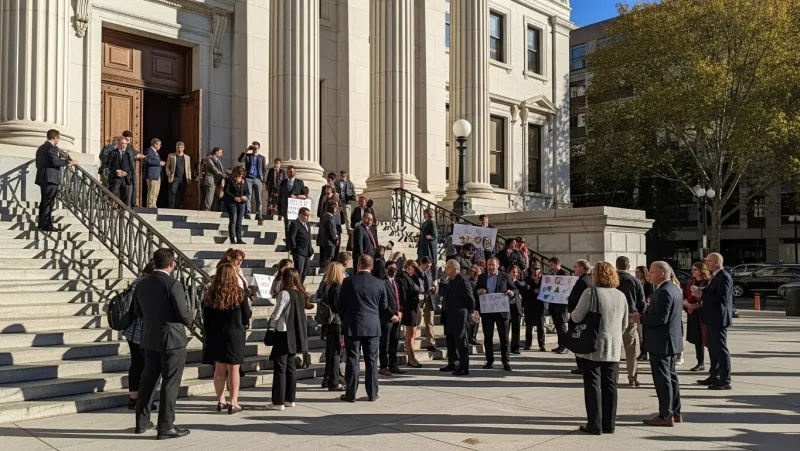
Facing a employment dispute in San Jose?
30-90 days to resolution. No lawyer needed.





Facing an Employment Dispute in San Jose? Here Is What the Data Says
BMA is a legal tech platform providing self-represented parties with the document preparation and local court data needed to manage California arbitrations independently.
This content is for informational purposes only and does not constitute legal advice. Consult a licensed California attorney for guidance specific to your situation.
Why Your Case Is Stronger Than You Think
In the legal landscape of San Jose, California, employment disputes often revolve around complex facts and legal nuances that can feel overwhelming. However, understanding how the foundational elements of your case align with California’s statutes and procedural rules can significantly strengthen your position. In particular, the ability to demonstrate clear documentation and adherence to statutory notice requirements can lock in crucial advantages.
$14,000–$65,000
Avg. full representation
$399
Self-help doc prep
California law emphasizes the importance of proper notice and evidence management. For example, under the California Arbitration Act, parties have a right to a fair process, provided they have maintained accurate records of employment contracts, communications, and performance reviews. When you systematically assemble comprehensive documentation—such as emails, performance evaluations, and signed agreements—you create a layered foundation that supports your claim, making it harder for the other side to dismiss or diminish your case.
Moreover, proactively informing your employer of your dispute and understanding contractual arbitration clauses can shift procedural momentum. Properly executed, these steps impose a discipline that both increases your credibility and aligns your case with statutory protections. Such preparation can sometimes even mitigate the employer’s ability to challenge your claim on procedural grounds, especially if you adhere to California's strict timelines for arbitration notices and evidence submission.
This strategic approach capitalizes on the legal framework that favors parties who rigorously document and timely act—upholding the essence of the legal standards that prioritize factual clarity and procedural adherence.
What San Jose Residents Are Up Against
San Jose’s employment scene reflects a high concentration of technology, retail, and service industries, with thousands of businesses and employees navigating employment disputes annually. The San Jose civil courts, as well as local ADR programs, handle a significant volume of employment-related cases—per the latest data, over 1,200 employment claims have been filed in Santa Clara County courts in the past year alone.
Additionally, enforcement patterns demonstrate that many employers in the region respond to disputes with attempts to enforce arbitration clauses or challenge claims on procedural grounds. The California Department of Fair Employment and Housing reports that workplace discrimination and wage and hour violations are among the most common issues faced by San Jose workers, with enforcement data indicating a steady increase—14% over the previous year—highlighting a persistent pattern of employment law violations.
Regional industry behaviors also reinforce the challenge: some employers routinely include arbitration clauses to deny employees access to courts, while others delay resolution by contesting procedural deficiencies or withholding critical evidence. This environment underscores the need for claimants to be prepared and to act swiftly, ensuring that their evidence and notices align with California statutes and local practices.
In this context, understanding the enforcement trends and industry behaviors equips claimants with the insight to anticipate potential defenses and procedural tactics, emphasizing the importance of meticulous preparation.
The San Jose arbitration process: What Actually Happens
In California, employment arbitration follows a structured process governed primarily by the California Arbitration Act (CAA). In San Jose, the typical timeline unfolds as follows:
- Claim Initiation (Day 1-30): The claimant files a written demand for arbitration through a designated provider such as AAA or JAMS, using specific forms compliant with local rules and the arbitration clause. The respondent then receives formal notice, triggering the procedural clock, often within 10 days. Statutory references include the California Arbitration Act (CA Civil Procedure Code §1280 et seq.).
- Selection of Arbitrator (Day 31-45): Both parties select an arbitrator, possibly from a pre-approved list, with procedures outlined in the arbitration agreement and governed by AAA Rules. California courts favor neutral arbitrators with no conflicts, reinforcing the importance of vetting prior to selection.
- Pre-Hearing Discovery and Hearings (Day 46-90): Limited discovery—such as document exchanges and witness lists—is permitted under California rules, although more restrictive than court litigation. Arbitrators set schedules, and parties submit evidence following strict deadlines. The timeframes may extend to 3 months, especially if witnesses or complex evidence are involved.
- Arbitration Hearing and Decision (Day 91-120): The hearing proceeds with presentations of evidence and oral arguments, often in San Jose’s local arbitration centers, under the governance of the AAA or JAMS. The arbitrator files an award typically within 30 days of the hearing, which is enforceable in California courts.
This process underscores the importance of timely preparation, thorough evidence collection, and understanding procedural frames to maximize claim strength in San Jose’s arbitration setting.
Your Evidence Checklist
- Employment Contract and Arbitration Clause: Fully signed copies, preferably with amendments or updates, in digital or paper format; deadlines for review often include the date of signing, which is critical for enforceability issues.
- Correspondence: Emails, text messages, or internal memos related to the dispute, preserved with timestamps, ideally in PDF format, to establish chain of communication.
- Performance Evaluations: Recent reviews, disciplinary reports, or acknowledgment documents; these can support claims of misconduct or performance issues relevant to the dispute.
- Payroll and Benefit Records: Timecards, wage statements, and benefit enrollment documentation—often stored electronically—crucial in wage and hour cases.
- Witness Statements: Written accounts from coworkers, supervisors, or HR representatives, ideally sworn and signed, with dates and contact details.
- Timeline of Events: A chronological record of key incidents, dates, and responses, maintained in a secure digital log, to maintain focus during negotiations and hearings.
Most claimants overlook the importance of establishing strict deadlines for collecting and updating these documents. Preservation of evidence—especially electronic communications—is critical to prevent claims of spoliation, which can weaken your position or lead to dismissals.
Ready to File Your Dispute?
BMA prepares your arbitration case in 30-90 days. No lawyer needed.
Start Your Case — $399People Also Ask

Is arbitration binding in California? Yes. Under California law, arbitration agreements are generally enforceable if entered into voluntarily and with proper notice. Courts uphold arbitration awards unless procedural defects or violations of fairness are proven.
How long does arbitration take in San Jose? Typically, the process ranges from three to six months from initiation to final award, depending on case complexity, discovery scope, and arbitrator scheduling.
Can I challenge an arbitration award in San Jose? Yes. California law allows for motions to vacate or modify arbitration awards based on procedural errors, arbitrator bias, or misconduct, filed within specific statutory deadlines.
What if the employer refuses arbitration? Employers cannot refuse arbitration if you have a valid agreement in place. You may need to initiate court enforcement to compel arbitration, where evidence of the agreement's validity is crucial.
Is evidence from electronic devices admissible in arbitration? Generally, yes. California arbitration rules accept electronic records when properly preserved, chain-of-custody is maintained, and authenticity can be demonstrated.
Don't Leave Money on the Table
Full legal representation typically costs $14,000–$65,000 on average. Self-help document prep: $399.
Start Your Case — $399Why Business Disputes Hit San Jose Residents Hard
Small businesses in Santa Clara County operate on thin margins — when a contract is broken, arbitration at $399 vs $14K+ litigation makes the difference between staying open and closing doors. With a median household income of $153,792 in this area, few business owners can absorb five-figure legal costs.
In Santa Clara County, where 1,916,831 residents earn a median household income of $153,792, the cost of traditional litigation ($14,000–$65,000) represents 9% of a household's annual income. Federal records show 590 Department of Labor wage enforcement cases in this area, with $10,789,926 in back wages recovered for 4,629 affected workers — evidence that businesses here have a pattern of cutting corners on obligations.
$153,792
Median Income
590
DOL Wage Cases
$10,789,926
Back Wages Owed
4.44%
Unemployment
Source: U.S. Census Bureau ACS, Department of Labor WHD. IRS income data not available for ZIP 95103.
PRODUCT SPECIALIST
Content reviewed for procedural accuracy by California-licensed arbitration professionals.
About Grace Allen
View author profile on BMA Law | LinkedIn | Federal Court Records
Arbitration Help Near San Jose
Nearby ZIP Codes:
Arbitration Resources Near San Jose
If your dispute in San Jose involves a different issue, explore: Consumer Dispute arbitration in San Jose • Employment Dispute arbitration in San Jose • Contract Dispute arbitration in San Jose • Insurance Dispute arbitration in San Jose
Nearby arbitration cases: Duarte business dispute arbitration • Carmel By The Sea business dispute arbitration • Avery business dispute arbitration • Helm business dispute arbitration • West Covina business dispute arbitration
Other ZIP codes in San Jose:
References
- California Arbitration Act: https://leginfo.legislature.ca.gov/faces/codes_displayText.xhtml?lawCode=CODEOF CIVILPROCEDURE&division=&title=3.&part=&chapter=2.5
- California Code of Civil Procedure: https://leginfo.legislature.ca.gov/faces/codes_displayText.xhtml?lawCode=CCP
- California Dispute Resolution Practice Guidelines: https://www.courts.ca.gov/selfhelp-disputeresolution.htm
What broke first was the unchecked reliance on a seemingly complete arbitration packet readiness controls checklist that masked critical lapses in document chain-of-custody discipline during a complex employment dispute arbitration in San Jose, California 95103. The silent failure phase lasted until the hearing—every signature and timestamp appeared intact, but behind the scenes, poor segregation of evidence streams and workflow boundary ambiguities had already corrupted evidentiary integrity. By the time the disconnect surfaced, it was impossible to reconstruct or authenticate key communications, irrevocably undermining credibility and invalidating hours of review. The jurisprudential and operational constraints in San Jose’s jurisdiction increased stakes, as local rules emphasize fast yet conclusive determinations, leaving no room for post-hoc fixes. Cost pressures pushed the team into a false economy of documentation speed over security, a trade-off they paid for in process irreversibility.
The initial assumption that all documentation had been properly indexed and verified became a catastrophic blind spot. Manual cross-checks were perfunctory and failed to identify variant versions slipped in due to insufficient chain-of-custody discipline, exacerbated by siloed communication across multiple booths and time zones. Despite meticulous scheduling and workflow boundary definitions, human error in evidence tagging left critical emails and HR records unlinked from the arbitration packet. This misalignment was invisible within the superficial audit trail, but once discovered, no retroactive correction could restore trust in the arbitration record’s reliability. Instead, the whole case’s evidentiary foundation was compromised.
Under the operational and legal constraints unique to employment dispute arbitration in San Jose, California 95103, this failure underscored the fragile balance between process speed and absolute documentation rigor. Attempting to accelerate review cycles without reinforcing verification protocols created an irreversible vulnerability in the ecosystem. The boundary between effective workflow execution and detrimental shortcut was never so viscerally clear, with consequences cascading across client trust and internal reputation. The failure altered future risk models, forcing re-examination of cost implications in arbitration undertakings and stricter adherence to procedural integrity.
This is a hypothetical example; we do not name companies, claimants, respondents, or institutions as examples.
- False documentation assumption: relying solely on checklist completion masked deep evidentiary defects.
- What broke first: the arbitration packet readiness controls created an illusion of completeness disrupting chain-of-custody discipline.
- Generalized documentation lesson tied back to employment dispute arbitration in San Jose, California 95103: ensure multiple convergent verifications of evidence origin within defined workflow boundaries to counteract irreversible documentation errors.
⚠ HYPOTHETICAL CASE STUDY — FOR ILLUSTRATIVE PURPOSES ONLY
Unique Insight Derived From the "employment dispute arbitration in San Jose, California 95103" Constraints
Arbitration in San Jose operates under stringent evidentiary rules that prioritize both speed and thoroughness, creating a constrained environment where documentation workflow errors cannot be easily rectified without significant operational cost. The pressure to maintain rapid case turnover often pushes teams to compromise on verification steps, inherently increasing risk. These trade-offs emphasize the necessity of systematic error detection as an ongoing, integrated process rather than a final-stage checklist.
Most public guidance tends to omit the latent complexity introduced by local jurisdictional nuances unique to San Jose—such as strict limits on discovery scope and accelerated timelines—which force arbitration teams to adopt expedited yet exacting document handling frameworks that magnify the impact of small chain-of-custody failures.
The operational boundaries in this arbitration context make it critical to embed ‘evidence of origin’ controls directly into the workflow rather than treating them as auxiliary safeguards. Failure to do so transforms minor lapses into irreparable evidence losses, a cost rarely acknowledged upfront but devastating in outcome.
| EEAT Test | What most teams do | What an expert does differently (under evidentiary pressure) |
|---|---|---|
| So What Factor | Rely on surface compliance and checklist completion without deep cross-validation. | Prioritize multiple-level verification tied directly to workflow checkpoints to detect silent failures early. |
| Evidence of Origin | Assume metadata and timestamps suffice to prove document authenticity. | Integrate chain-of-custody discipline with proactive anomaly detection to safeguard provenance. |
| Unique Delta / Information Gain | Aggregate evidence without contextual linkage, risking loss of traceability. | Correlate multi-source evidence with chronological integrity controls to maximize information fidelity. |
Local Economic Profile: San Jose, California
N/A
Avg Income (IRS)
590
DOL Wage Cases
$10,789,926
Back Wages Owed
In Santa Clara County, the median household income is $153,792 with an unemployment rate of 4.4%. Federal records show 590 Department of Labor wage enforcement cases in this area, with $10,789,926 in back wages recovered for 5,329 affected workers.
